Nemanja Živković, Strategy Director, Founding Partner · 22 November 2026
I Sold Fractional CMO for Four Years. Here Is When It Works.
A fractional CMO works when there is already a system to run. When there isn't, you are paying a senior person to spend six months building it. What I used to sell, what I saw, and the five questions to ask before you hire one.
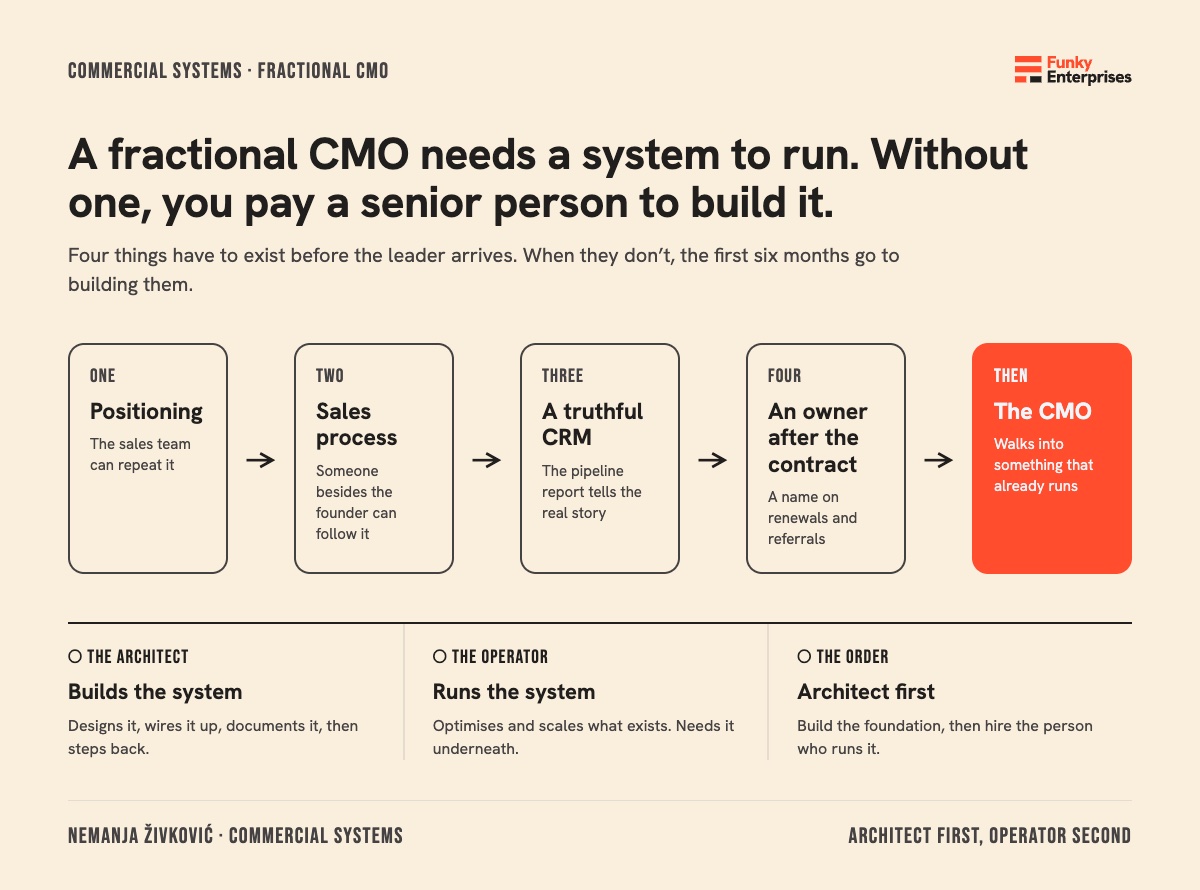
A fractional CMO is worth hiring when the company already has a commercial system for that person to run: positioning the sales team can repeat, a sales process someone other than the founder can follow, a CRM that tells the truth about the pipeline, and a name next to what happens after the contract is signed. When those four are missing, you are not really hiring a CMO. You are paying a senior person to spend the first six months building what should already exist, at a senior day rate, with the board asking every month why pipeline has not moved.
I know this because for about four years I sold the other version.
What I used to say
From 2021 until 2025 I was a fractional CMO, and I was loud about it. In 2024 I wrote it plainly: you don't need a CMO or VP in-house until you're around $5M-$10M in revenue. You need me. I wrote that the role is transitional, six months, a year at most. I took two or three companies a year, because that was all I could do properly.
The arguments were good, and most of them still hold. A fractional leader costs less than a full-time VP or CMO. Companies listen to an outside voice in a way they rarely listen to their own people. And both sides get to see whether the fit is real before anyone signs a five-year plan.
The best example from that time is Hybrid Digital, before Funky Enterprises existed. It was a client that needed a fractional CMO to get where it wanted to go, so I stepped in. We analysed the business, set up the foundation and the strategy, put the right people in the right positions, and then oversaw the implementation. At the same time we ran campaigns for their biggest clients, mostly SaaS companies from the DACH region. During that time the company was acquired by Typeqast, one of its own clients, and we wrote the strategic narrative that made that shift make sense to everyone involved.
That engagement worked. Looking back, I can see why, and it was not because of the title on my LinkedIn profile.
What I saw
The engagements that worked had something in common. There was already a business that sold, a team that could execute, and a founder willing to let someone else decide. My job was to point that system in a direction and keep it honest.
Then I kept getting a different kind of call. A company has just raised, the board wants pipeline, and the founder wants a senior marketing person. When we talked it through, positioning lived in the founder's head, sales was the founder plus a CRM nobody trusted, and nobody owned the customer after the invoice. Whoever they hired, fractional or full-time, would spend the first months building the things marketing needs in order to exist, and get measured on pipeline the whole time.
The person is rarely the problem there. The job and the role do not match. In 2025 I changed the model for exactly that reason: most companies asking for a fractional CMO need the system first, and the leader after it.
Two different jobs
There are two kinds of senior marketing people, and most hiring goes wrong because companies treat them as one.
The operator runs an existing system brilliantly. They optimise, scale and improve, and they need infrastructure underneath them to be effective.
The architect builds the system from scratch. They design it, wire it up, document it, and then they leave or step back.
Most companies hire for operator skills with architect expectations, then wonder why it doesn't work. A fractional CMO sold as an operator, dropped into a company with nothing to operate, is the most expensive version of that mistake. In basketball terms, you signed a point guard for a team with no plays and no big man, and you expect him to run an offence that does not exist yet.
The order that works is architect first, operator second. Build the foundation in a few months, then hire the person who runs it, either full-time or fractional.
Five questions before you hire one
Answer these honestly before you sign with a fractional CMO or post the job ad for a full-time one.
- Can your sales team say, in one sentence, what makes a conversation worth their time? If not, you need one written definition of an opportunity before you need a leader.
- Do you know which marketing activities produce revenue, and which only produce activity? If not, the first job is measurement, and that is a system job.
- Can someone other than the founder describe the offer in a way that sounds like the company? If not, the positioning still lives in one head.
- Does your CRM tell you the real story of your pipeline? If not, any leader will spend their first quarter cleaning data.
- Could a new senior hire be productive in the first week? If the honest answer is month six, there is nothing written down for them to step into.
If you answered no to three or more, hiring a CMO first, fractional or full-time, puts the most expensive person on the team in front of work nobody has scoped.
When a fractional CMO is the right call
I am not against the model. It is the right call in three situations.
When the system exists and the person who ran it has left. A fractional leader can hold it steady and help you hire the next full-time person.
When you need an outside voice for six to twelve months to make a decision the team cannot make on its own, such as a new market, a new segment or a pricing change.
When the company is too small for a full-time CMO but already sells repeatably, and the bottleneck is direction rather than infrastructure.
In all three, the leader has something to lead. That is the condition. The title matters much less.
What we do instead
At Funky Enterprises, the people who design the commercial system also build it and run it with you: positioning, marketing, sales and customer success, plus the CRM and data the system runs on. Then, when the system runs, the operator you hire next, fractional or full-time, steps into something that is already moving.
Usually the first step is a diagnosis. Before anyone writes a plan, we spend a few weeks inside the real numbers to see where the system leaks, because the hire you need depends on what is actually broken. If it turns out you really do need a fractional CMO, we will tell you that too.
If you are about to hire your first marketing leader, ask yourself one thing first. Is there a system for that person to run, or are you hoping they will build it while also being measured on running it?
Written by
Nemanja Živković, Strategy Director and Founding Partner at Funky Enterprises. He builds commercial systems for B2B companies: positioning, marketing, sales and customer success working as one. More about Nemanja · nemanjazivkovic.co