Nemanja Živković, Strategy Director, Founding Partner · 20 October 2026
The Work That Feels Like Work
Every founder I met this month wants more customers. Almost none will change a single thing they do between nine and five to get them, because the day already feels productive.
In the first week of September my partner and I spent a few days with two friends on the coast near Split. They run a small advisory practice together, the kind a founder calls when a decision has been stuck for a month and nobody in the building wants to say so. We ate at their table most evenings, and over three or four nights the conversation kept coming back to the same question. Why do companies stall when they start to grow, and why do some of them sink after the biggest year they ever had?
I came home with a list on the back of a ferry ticket. A week later I was on a call with a company that wanted more customers, listening to the owner explain why nothing about the way they worked could change, and the list got its title. The work that feels like work.
Below are three ways I have watched growth die, and the thing underneath all three. There is no solution at the end, on purpose, because the person reading usually has the fix and has not noticed the problem.
The call
It was a real business, with real customers, a real service and people who have been paid on time for years. Revenue had been flat for two years and the owner wanted more customers, more or less in those words.
I asked what a normal week looks like. The answer was long, detailed and proud, and fairly so. Deliveries go out, clients get their reports, the team meets on Monday, invoices go out on Friday, a spreadsheet tracks every project and somebody checks the support inbox twice a day.
Then I asked which of those things produces a new customer. None of them did. New customers came from referrals when they came, and the last one came in March.
So I asked what they would be willing to change, as opposed to add, meaning something that happens between nine and five that would stop so something else could start. The answer, delivered kindly, was that nothing could change, because all of it was necessary. The Monday meeting, the reports, the owner personally reviewing every deliverable before it goes out.
I believe them. Every one of those things is necessary for the business they have, and none of them is necessary for the business they say they want. They can't see the gap because the day feels productive. It is full, it has structure, people are busy and things get done. It is real work, and it still does not bring in a customer.
Killing the spring
The first pattern from the table near Split is the one our friends see most, because they get called after it has happened.
A services company does well, the kind where a client pays for people's time and judgement. The margins are decent, and after a few years the founders look at revenue, decide it does not scale, and start building a product that will earn while they sleep.
Somewhere in the second year of building, they start to resent the services work. It pulls the best people away from the product, and clients keep asking for things that do not fit the roadmap. So they wind it down, stop taking new clients, let the old ones lapse and move everyone onto the product.
What they have switched off is the spring. The product idea came from services, because you only know what to build when you are inside the client's problem every week. Services produced the first product customers too, since the people who trusted them with a project were the ones willing to try the software. And services paid the salaries while the product found its feet. Shut it down and cash gets tight, the roadmap goes quiet because nobody talks to clients any more, and the first customers never get replaced.
I feel the pull myself. Every year some work pays well and does not fit the story I want to tell about the company, and every year I have to decide again whether focus is the honest word for dropping it, or whether I am just bored of the thing that works.
Selling the life
The second pattern I see mostly on LinkedIn, and I have been guilty of it too.
A founder grows a company to the point where it runs without them for a week, which is a real achievement that took years. Then they start talking about it. The morning routine, the remote team, the month in Lisbon, the four-day week, no calls before ten.
All of it is earned. The prospect, though, came with a problem, and the founder is now selling the life they built, which the prospect has no use for. The lifestyle is a receipt. It proves the business worked, and it tells the prospect nothing about their own problem.
I have watched this cost people clients. A prospect reads three months of posts about freedom and the beach, concludes, reasonably, that the founder is done and the hunger is gone, and books with somebody who still sounds like they need the deal. Talk about the client's result more than your own, and keep the beach for your friends. Easy to say, hard to do.
The offer was never built
The third pattern sits under the other two, and our friends on the coast were clear that it is behind most of the stalls they get called into.
A company grows on the strength of the founder, who is good in the room, closes the deals, sets the price by feel and delivers or supervises the work closely. Revenue rises for a few years and then stops, because the founder has run out of hours.
At that point the company needs four things it has never had. An offer someone other than the founder can describe in a paragraph. A way to measure the effect of the work that does not depend on the founder's judgement. A resourcing model, meaning a clear answer to who does what and how long it takes. And a way of thinking about the work that lives in the team, so a hard client question does not have to route through one person.
Most companies at this stage have none of the four, only a founder who carries them in their head and a team that has learned to ask the founder. Sooner or later that founder becomes the bottleneck.
Building those four things is slow, it brings no revenue this month, and it feels like admin, the kind of thing you will get to when it is quieter. It never gets quieter. Meanwhile the deliveries go out, the reports get sent, the Monday meeting happens and every day feels productive.
What the title means
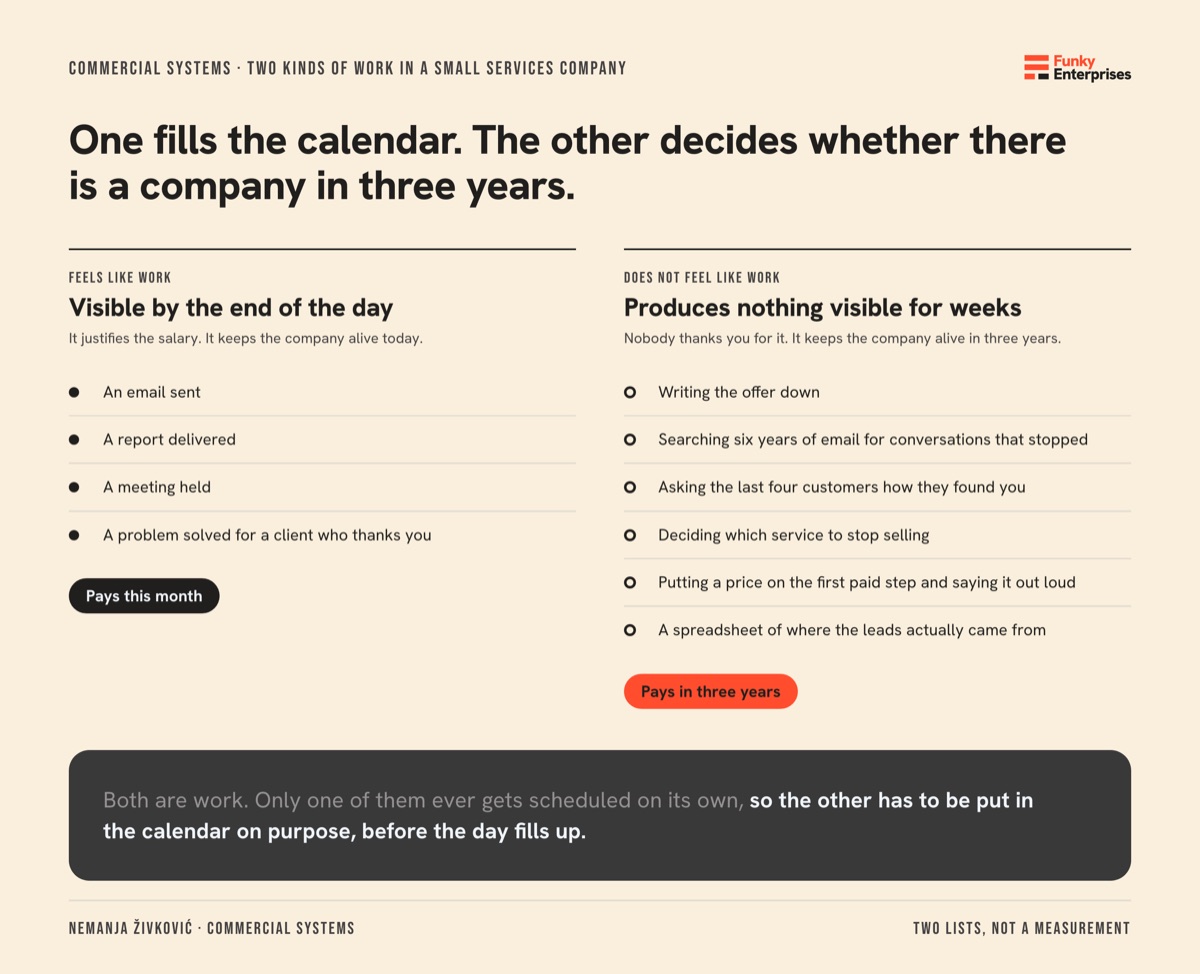
One kind of work has a rhythm. By the end of the day it produces something you can see, an email sent, a report delivered, a meeting held, a client who thanks you. It fills the calendar and justifies the salary, and the company would fall over without it.
The other kind does not feel like work at all: writing the offer down, searching six years of email for conversations that stopped, asking the last four customers how they found you, deciding which service to stop selling, putting a price on the first paid step and saying it out loud, sitting with a spreadsheet of where the leads really came from. None of it shows by the end of the day, a lot of it shows nothing for weeks, and all of it decides whether there is a company in three years.
None of the people in these stories were lazy or stupid. Each of them was doing the first kind of work well and letting it crowd out the second, because the second never gives you the feeling of having done something.
Why I stop at the description
The fix is different for every company, and the person running it usually knows it already. The owner on the call knows which Monday activity could stop, and the founders with the product know they could restart some version of the services arm.
What they lack is somebody outside the building saying plainly what they saw: the day is full and the pipeline is empty, the thing they stopped was the thing that worked, the offer lives in one head. That is what our friends near Split do for a living, it is what I ended up doing on that call the following week, and it is what I am doing here. In my experience a clear description from someone with no stake in it moves people faster than most solutions.
On Friday, for paid subscribers, I will go through one piece of that second kind of work in detail, publishing research on a market where you have no clients yet, and what came back to us when we did it three times this summer.
If you know a founder whose calendar is full and whose pipeline is quiet, forward this to them. It is easier to hear from a newsletter than from someone across the table.
Written by
Nemanja Živković, Strategy Director and Founding Partner at Funky Enterprises. He builds commercial systems for B2B companies: positioning, marketing, sales and customer success working as one. More about Nemanja · nemanjazivkovic.co
Also published in the Commercial Systems newsletter. Read it on Substack