Nemanja Živković, Strategy Director, Founding Partner · 22 November 2026
RevOps Is Not a Department You Rename
What to fix before anyone touches the CRM, why the gap between marketing and sales survives new tools, and what to ask a RevOps or CRM partner before you sign.
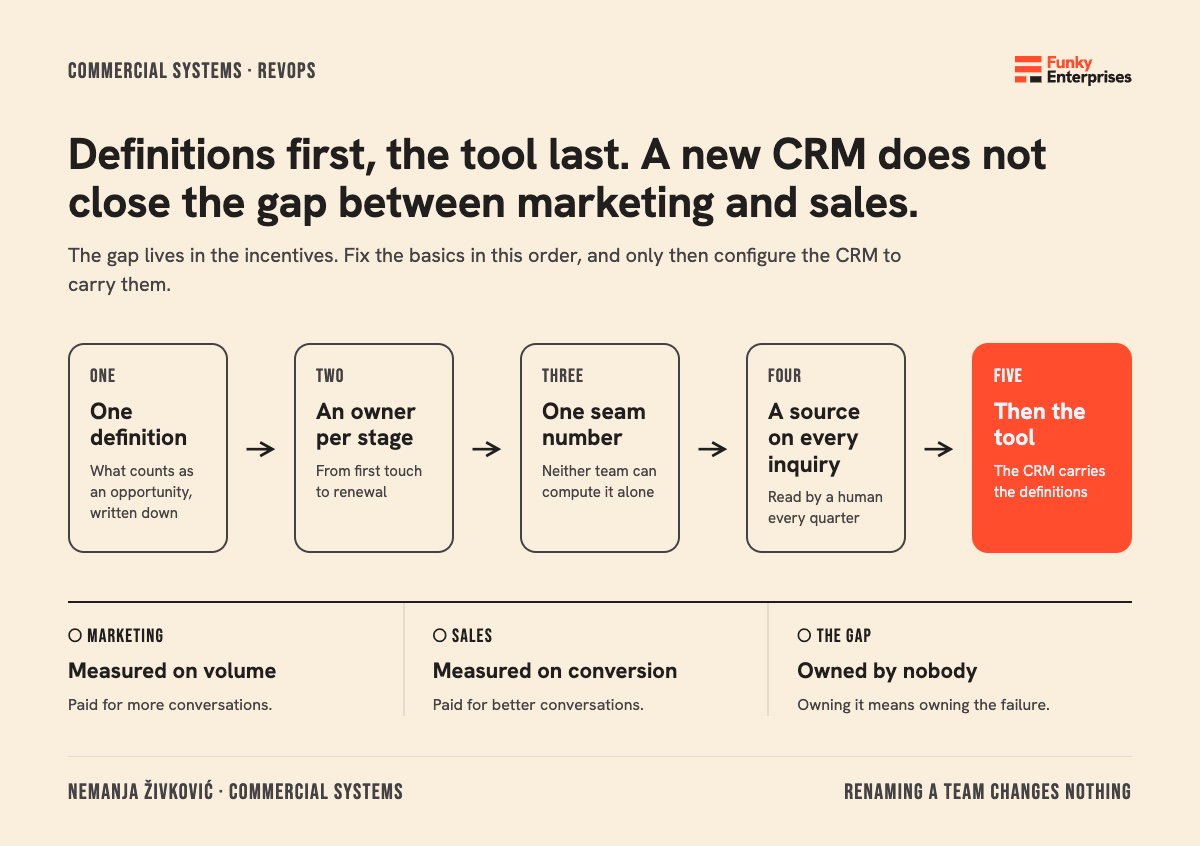
A good RevOps or CRM partner starts with definitions and gets to the tool last. Before anyone configures a pipeline, marketing, sales and customer success need one written definition of an opportunity, a named owner for every stage from first touch to renewal, and one number they all share. Without those three, you can replace the CRM, hire a RevOps lead and run alignment workshops, and the gap between marketing and sales survives all of it.
What I wrote in 2021
In April 2021 I wrote that renaming your sales team to a RevOps team, and your head of sales to chief revenue officer, does not make you a company that changed the system. It makes you a company that lies to itself, and you pay for it sooner or later.
The point was never the title. Revenue operations means getting marketing, sales and customer success to work as one, with accountability for the whole funnel shared between them. If the three teams keep their own goals, their own definitions and their own reports, a new name on the org chart changes nothing about how a deal moves.
Five years later I would say it more politely. I would not say it differently.
Why the gap survives the tools
The fight between marketing and sales about lead quality is rarely about leads. It is a proxy for a question nobody wants to ask out loud: whose number matters more?
Look at how most companies measure the two teams. Marketing is measured on volume, sales on conversion. With that setup they will never agree on what a good lead looks like, because one side is paid for more and the other side is paid for better. Nobody owns the gap between them, because owning the gap means owning the failure when it does not convert.
A new CRM does not touch that. Neither does a lead scoring model, a dashboard or an offsite. The gap is built into the incentives, so the fix has to start there.
The custom CRM story
A company I know spent the better part of a year and well into six figures building its own CRM. By launch it did a fraction of what an off-the-shelf tool does for a fraction of the cost. When I asked the CEO why, he said they needed something tailored to their business.
They didn't. They needed someone to tell them the truth, and my reading is that the problem was never the software. Tailoring a tool does not help when nobody has agreed on what the tool should count.
Before any build or buy decision, I ask the same three questions. The first comes from Geoffrey Moore: is this your core, or is it context that everyone in your market needs anyway? Does building it create an advantage that compounds, or a maintenance burden that grows? And what is the total cost, including the costs you are not counting, such as the people who will maintain it after the vendor leaves?
What to fix first, in order
This is the order we follow on our own funnel, and the order we bring to the sales process of a client we work with now.
- One definition of an opportunity. We use four questions about budget, authority, a problem the buyer knows they have, and a timeframe. Three of four, confirmed by a human in a conversation, is an opportunity. Anything less is an inquiry. Marketing counts inquiries, sales counts opportunities, and the conversion between them belongs to both.
- A name next to every stage. From first touch to signed contract to renewal, each step has one owner. The step most companies leave empty is the one after the signature, which is exactly where renewals and referrals come from.
- One seam number. Pick a number neither team can compute alone, such as how many conversations from marketing sales accepted as worth their time, or the hours between the form and the first call. Put it in front of the CEO every month.
- A source on every inquiry. Ask every new inquiry where they heard about you, write the answer down, and look at it by source once a quarter. It tells you more than most attribution reports.
- Then the tool. Configure the CRM to carry those definitions. Stages that match the definition, required fields that match the questions, and a report that shows the seam number without anyone exporting a spreadsheet.
Most CRM projects run this list in reverse. They start with the tool, import the old data with the old habits, and discover at the end that nobody agrees on what a stage means. CRM hygiene comes before sophistication, and many B2B companies we meet still have not got the basic hygiene right.
What to ask a RevOps or CRM partner
Whoever you are talking to, these questions separate the partners worth hiring from the rest.
Do they ask for your definitions before they ask for your login? A partner who opens with the tool will build you a faster version of the confusion you already have.
Will they work in the CRM you already use? Most companies do not need a migration. They need the tool they are paying for to reflect how they actually sell.
Who owns the system after they leave? If the answer is them, you have bought a dependency. If the answer is a named person on your team, with documentation they can follow, you have bought a system.
Are the people who design it the same people who build it? Many projects fail in the handover between whoever wrote the plan and whoever has to wire it into the pipeline.
What we do
Funky Enterprises works with B2B companies from Novi Sad, across Serbia, the Balkans and the rest of Southeast Europe, and with clients further afield. We run this on ourselves first. Every inquiry gets a source, every first call gets the four questions, the active accounts get a short review every week, and once a quarter we look at which sources bring people who are ready to buy. With clients, we design the definitions, stages and handoffs between marketing, sales and customer success, and work inside the tools the client already uses. Right now that includes the sales process of a client whose pipeline lives in a workspace tool rather than a classic CRM. The definitions work there too, because they never depended on the software.
The view is older than Funky Enterprises. Before it existed, one of the projects that shaped it was UserGuiding, where the work was a review of the sales process and getting marketing and sales to work from the same picture.
When we are not sure where the funnel breaks, we start with a diagnosis inside the real numbers, because the CRM nobody has cleaned is usually where the real story lives.
One question to end with. If you asked your head of marketing and your head of sales, separately, what counts as an opportunity, would you get the same answer?
Written by
Nemanja Živković, Strategy Director and Founding Partner at Funky Enterprises. He builds commercial systems for B2B companies: positioning, marketing, sales and customer success working as one. More about Nemanja · nemanjazivkovic.co