Nemanja Živković, Strategy Director, Founding Partner · 17 November 2026
The Fourth Function
Positioning, marketing, sales. Most companies stop counting there. The fourth function is where renewals and referrals come from, and in most commercial systems it has no owner and no number.
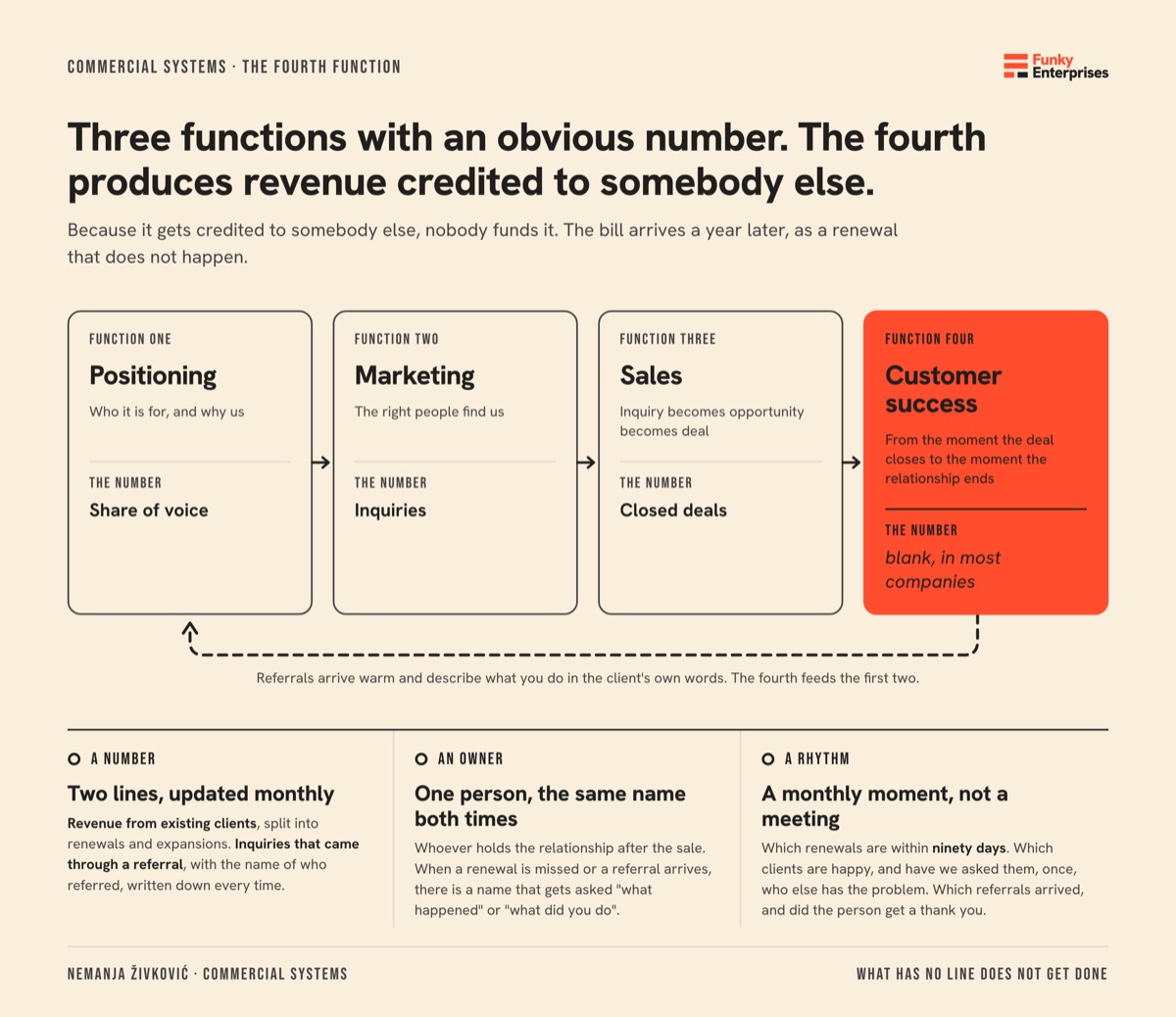
When I describe what we build, I say a commercial system is positioning, marketing, sales and customer success working as one machine. People nod at the first three. The fourth one gets a small pause, sometimes a polite question about whether I mean support, and then the conversation moves back to the parts that feel like they generate money.
I understand the pause. Customer success sounds like a department in a software company with a hundred employees, a team that onboards users and answers tickets. For a company of twelve people selling a service, or a manufacturer with a sales team of three, it sounds like someone else’s problem. This piece is about why it is not, and about a mistake in our own numbers this summer that showed me how expensive the missing fourth function is even for a company that talks about it for a living.
What the fourth function is
Strip the word customer success of its software connotations and what is left is simple. It is the part of the commercial system that starts the moment the deal closes and ends the moment the relationship does. Everything between those two points, the delivery, the check-ins, the renewal conversation, the moment a happy client mentions you to someone else, sits in the fourth function.
Now ask who owns it in a typical company. Sales closed the deal and moved to the next one. Marketing was never involved with this particular person after the first touch. Delivery, whoever does the actual work, owns the work but not the relationship, and often not the number either. The account has an owner on paper. In practice, the moment of renewal arrives as a surprise, and the referral, when it happens, is credited to luck.
That is the seam I wrote about in September, between marketing and sales, except it sits one step later, between sales and everything after. And like the earlier seam, the sign that nobody owns it is that nobody can tell you the number that lives there.
The number nobody had
This summer I ran a quarterly review of our own pipeline. We track it properly, or thought we did: every inquiry, where it came from, whether it turned into an opportunity, whether it closed. The review is meant to answer a simple question about brand health, which is whether the right people are coming to us, from where, and how often.
The log said one inquiry that quarter and nothing won. I knew that was wrong, because I had signed a twelve-month contract in May and it was sitting in a folder on my drive. When we reconciled the log against contracts, invoices and inboxes, the real picture was roughly eight inquiries and a signed deal that had never entered the system. The contract existed. The invoices existed. The log did not know.
Fixing that took a day and an automated reconciliation that now runs every morning. But the more interesting thing came out of the fix. When we went back through the deals we had won that year and asked where each one had come from, the honest answer for most of them was not a channel. It was a person. A former client who mentioned us to someone. A participant in a workshop we ran who came back two years later with a company of their own. An introduction from a partner we had done good work for.
None of those had been logged as anything, because the system had no category for “a client we treated well told someone”. The sales log had inquiry sources for calls, messages, email, podcasts, events, comments. Referral was on the list. But nobody had written down who referred, or why, or what we had done to earn it. The origin of most of our revenue that year was, in our own records, blank.
Why the number is blank in most companies
I have seen the same blank in almost every company we work with, and the reason is structural, not careless.
The first three functions each have an obvious number. Positioning has share of voice, or how often you come up when the right people search. Marketing has inquiries. Sales has closed deals. Each function reports on its number, each number goes up or down, and the company steers by it.
The fourth function’s number is the output of the other three arriving late. A referral this month is the result of work delivered eight months ago. A renewal in December is the result of every check-in since January. There is no campaign to point at, no launch date, no obvious cause. The money shows up and gets attributed to whichever channel the person touched last, which, as I wrote last week, is usually direct, the row that means “we do not know”.
So the fourth function produces revenue that gets credited to somebody else, and because it gets credited to somebody else, nobody funds it. The customer success work, the check-ins, the honest report every month, the call when nothing is wrong, looks like cost. Cutting it looks free. The bill arrives a year later as a renewal that does not happen and a referral that goes to someone else, and by then nobody connects it to the cut.
What owning it looks like
I am going to describe this at the size of a company that has one person doing sales, because if it works at that size it works at every size above it.
The fourth function needs three things: a number, an owner, and a rhythm.
The number is the simplest part and the part most companies skip. Two lines, updated monthly. Revenue from existing clients, split into renewals and expansions. And inquiries that came through a referral, with the name of who referred, written down every time. The first line tells you whether the relationships are holding. The second tells you whether they are producing. Neither requires a tool. A sheet does it.
The owner is whoever holds the relationship after the sale. In a small company that is usually the founder, or the person who delivers the work. It does not matter who, as long as it is one person and they know the two lines are theirs. The test is that when a renewal is missed or a referral arrives, there is a name that gets asked “what happened” or “what did you do”, and it is the same name both times.
The rhythm is a monthly moment where the owner looks at the two lines and does something. Not a meeting, a moment. Which renewals are within ninety days, and has anyone spoken to the client about anything other than the work. Which clients are happy, and have we asked them, directly and once, whether they know anyone who has the problem we solve. Which referrals arrived, and did the person who referred get a thank you that was more than a line in an email.
That last one sounds soft and it is the hardest to sustain. Our own experience this year was that the people who sent us business had never been told that we knew. Not because we were ungrateful. Because the system had no line for it, and what has no line does not get done.
Start the renewal a quarter out
One more thing about the rhythm, because it is where most of the money in the fourth function actually sits. Renewals are usually treated as an event, a date on which a contract ends and a new one is or is not signed. Treated that way, the renewal conversation happens in the last two weeks, under time pressure, with the client already having decided.
The companies that keep their clients treat the renewal as a conversation that starts a quarter out. Ninety days before the end, the owner of the relationship asks the client, plainly, what has worked, what has not, and what they would want to be different. That question is not a pitch. It is the only reliable way to find out, while there is still time to act on it, whether the renewal is at risk. A client who says “honestly, we are not sure the second half delivered” in September can be answered in October. The same sentence in December is a churn.
And when a client cannot renew, for cash reasons or timing, the answer is the pause I wrote about last Friday, with a letter and a clear return path, rather than a silent ending. Half of what the fourth function does is make sure relationships end in a state they can restart from.
The thing you can steal from software companies
There is one idea from the software world worth taking, and it is not the ticketing tool. It is the distinction between reactive and proactive contact.
Reactive contact is when the client reaches out. Something is wrong, or they need something, or the invoice is due. Every company does reactive contact, because the client forces it. Proactive contact is when you reach out with nothing to sell and nothing broken. A note about something you noticed in their market. A question about how the thing you built is being used. A heads-up that a change is coming that might affect them.
The software companies that run this well treat the ratio of proactive to reactive contact as a leading signal for renewal, and I do not have their data, but I have watched our own relationships closely enough to believe it. A client who only hears from you when something is wrong or due associates you with things being wrong or due. A client who hears from you when nothing is happening associates you with attention. It is not complicated. It is just not free, and in a company where nobody owns the fourth function, it is the first thing to go.
The monthly report I wrote about two weeks ago is the most reliable form of proactive contact we have. It arrives whether or not anything is wrong. It contains a decision, so it demands a reply. And it is signed by the person who owns the relationship, so the client knows who to call when they want to refer someone.
How this feeds the other three
I want to close the loop, because the whole point of calling it a system is that the functions feed each other.
The fourth function feeds positioning, because the clearest description of what you do comes from clients who have lived it. The clients who refer us describe what we do in their own words, to people who trust them, and those words are worth more than any line on our site. The fourth function feeds marketing, because a referred inquiry arrives warm, skips half the funnel, and closes at a rate a cold one never will. And it feeds sales, because the sales conversation with a referred prospect starts from trust and moves to fit, instead of starting from doubt and moving to price.
A company that runs three functions and lets the fourth happen by itself is running an engine with the exhaust disconnected. It works. It also loses the part of the output that would have fed back in.
We fixed our log. We went back and wrote the origin of every deal we had won, with a name where there was one. The monthly moment goes on the calendar from this month. It is early and I do not have a number I would put in front of you yet. What I have is a blank that is no longer blank, and a list of people who sent us business who have now been told that we know.
One question. Look at the last three clients you won. Can you name, for each one, the person who first said your name to them? If you can, that is your fourth function working. If you cannot, it is working anyway, and you are not watching.
Written by
Nemanja Živković, Strategy Director and Founding Partner at Funky Enterprises. He builds commercial systems for B2B companies: positioning, marketing, sales and customer success working as one. More about Nemanja · nemanjazivkovic.co
Also published in the Commercial Systems newsletter. Read it on Substack