Nemanja Živković, Strategy Director, Founding Partner · 22 November 2026
Six Stages, One Definition: How Marketing Becomes Accountable for Revenue
Marketing reports on leads, sales reports on deals, and the two numbers never meet. The six layers we measure, and the one definition that makes them add up.
Every argument I have watched between a marketing lead and a sales lead goes the same way. Marketing says it delivered a hundred and forty leads this quarter. Sales says maybe nine of them were worth a call. Marketing says sales did not follow up, and sales says there was nothing to follow up on. The CEO has to set next quarter's budget from two numbers that describe the same people and can't be reconciled, so they pick the one that supports what they already wanted to do.
Both sides are telling the truth. The word "lead" means one thing to the person who generated it and another to the person who has to call it, and nobody ever wrote the definition down. Marketing becomes accountable for revenue the day that definition exists, because from then on marketing and sales are counting the same thing.
The one definition
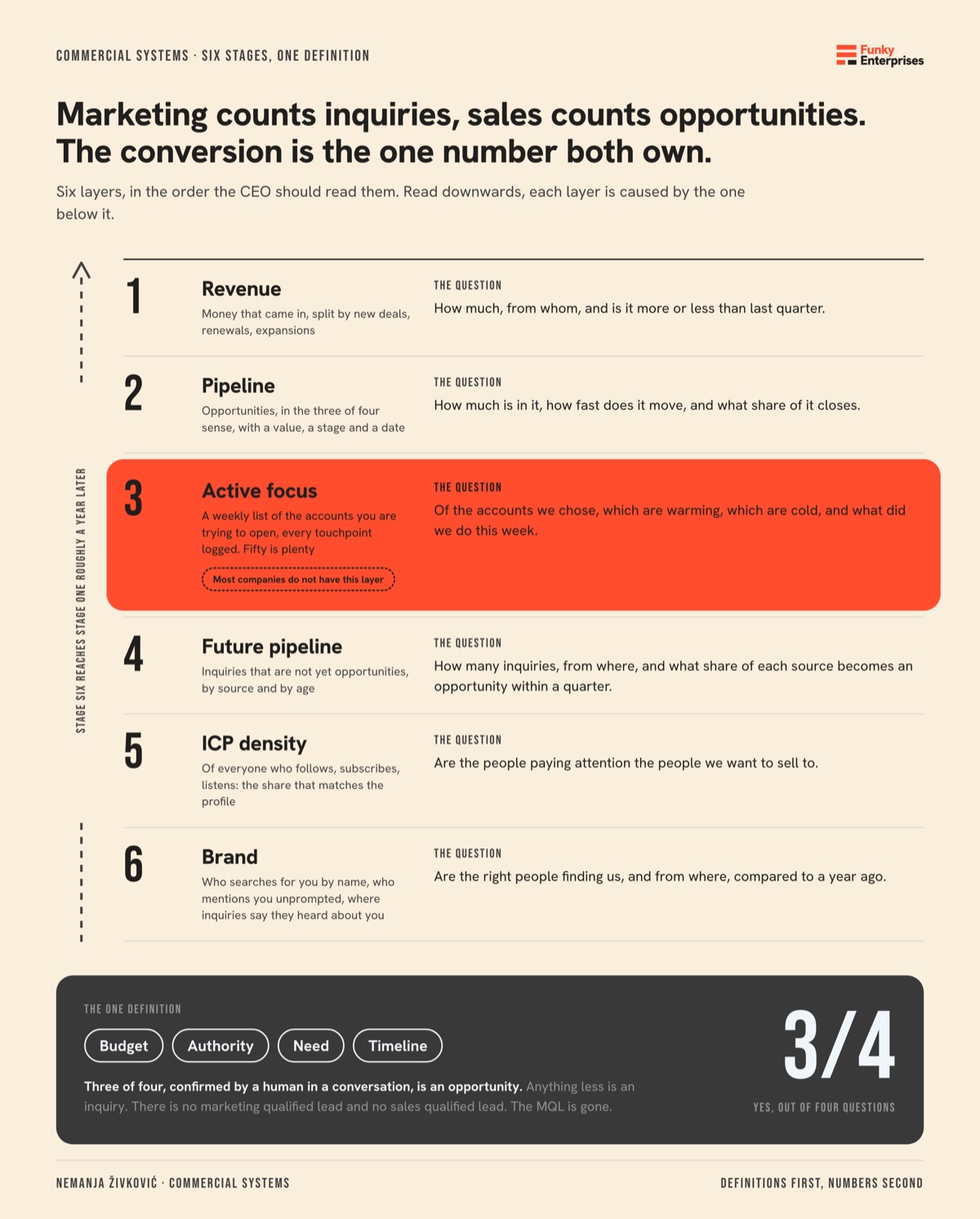
An opportunity is a person who said yes to at least three of four questions. Is there budget, or a path to it? Is this the person who decides, or close enough to bring the decider in? Do they have the problem we solve, and do they know it? Is there a reason it needs solving in a timeframe we can name? Three of four, confirmed by a human in a conversation, is an opportunity. Anything less is an inquiry.
That kills a word. There is no marketing qualified lead and no sales qualified lead. Marketing counts inquiries, sales counts opportunities, and the conversion between them is the one number both of them own. It ends the argument because it is the same number on both sides.
We run this on ourselves. Every inquiry into Funky Enterprises gets a source, one of seven: a booked call, a LinkedIn message, an email, a referral, a podcast, a speaking event or a comment. Every inquiry gets the four questions on the first call. Once a quarter we look at the inquiry-to-opportunity rate by source, to see which doors bring people who are ready and which bring people who are curious.
The MQL was invented so marketing could hand something to sales without a human conversation, and at thousands of inbound signals a month that makes sense. Most B2B companies are processing dozens. At dozens, a scoring model is a way of avoiding the ten-minute call that would have answered the four questions.
The six stages
They run from the money backwards, because that is the direction the CEO reads in, and because each layer explains the one before it.
- Revenue. Money that came in, split into new deals, renewals and expansions. How much, from whom, and is it more or less than last quarter.
- Pipeline. Opportunities in the three-of-four sense, each with a value, a stage and a date. A pipeline made of opportunities can be trusted. A pipeline made of leads can't.
- Active focus. A weekly list of the accounts you are actively trying to open, with every touchpoint against each one. Fifty accounts is plenty. This is where marketing and sales sit in the same room, because the touchpoints belong to both.
- Future pipeline. Inquiries that are not yet opportunities, by source and by age. This is marketing's number, and it is a real one, because it feeds stage two on a lag you can measure.
- ICP density. Of everyone who follows you, subscribes or listens, the share that matches the people you want to sell to. Ten thousand followers at two percent density bring fewer good inquiries than two thousand at thirty.
- Brand. Who searches for you by name, who mentions you unprompted, and what inquiries say when you ask where they heard about you. It is the slowest layer, and it moves over quarters.
Why the order matters
Revenue comes from pipeline, pipeline comes from active focus and future pipeline, future pipeline comes from density, and density comes from brand. Read the other way, a change at stage six shows up at stage one roughly a year later. That is why brand work feels like a cost: it is paid for in one quarter and collected in another, and no report connects the two.
Put the six numbers on one page in that order and the CEO can see where it breaks, without any attribution model. If revenue is down and pipeline is fine, the problem is closing. If pipeline is thin and future pipeline is full, the problem is qualification, and the definition is the fix. If future pipeline is empty and brand is healthy, the problem is the path from attention to inquiry, which is usually the site or the offer. If brand is flat, everything downstream will be flat in a year, whatever the campaigns say.
Most companies report on stage one and on something that looks like stage four but is really a count of form fills. The two don't connect, and the argument lives in that gap.
The smallest version
Nobody builds all six in a month. The smallest version that works is three moves, the same three we started with.
First, kill the MQL. Define an opportunity as three of four, put the four fields on every inquiry and make the first conversation the qualification step. It takes a week and fixes stages two and four at once.
Second, a weekly active focus review: target accounts, touchpoints logged against each, twenty minutes on Monday with whoever does marketing and whoever does sales on the same call. It is the most useful meeting in a commercial system and it costs almost nothing.
Third, a monthly density check. Take a sample of followers or subscribers and count how many match the profile. It can be rough. It has to be repeated, so the number has a direction.
We stalled on the third ourselves, for an embarrassing reason: we had not written our own ideal customer profile down precisely enough to filter by it. We had it in our heads, which is exactly where the MQL problem starts. If you find the same blank in your company, that is the step to expect to stall on.
The objection
Time. If every inquiry gets a conversation, somebody has to have it, and when the founder is also the sales team that is the founder's afternoon. Forty inquiries a month at fifteen minutes each is ten hours they don't have.
Those ten hours are already being spent, just later and worse. An unqualified inquiry that gets a proposal costs an afternoon. One that gets a demo costs an hour of two people. The first call is the cheapest place in the whole system to find out there is no budget.
And forty a month usually means the definition is too wide. Newsletter signups and downloads are not inquiries. An inquiry is a person who asked a person for something. In a pick-up game nobody counts the people watching from the fence as players. The fence matters, that is stages five and six, but you don't run a play for it.
If your marketing lead and your sales lead can sign the same six sentences, you have a commercial system. If they can't, you have two departments, and the report will keep showing two numbers that never meet.
Written by
Nemanja Živković, Strategy Director and Founding Partner at Funky Enterprises. He builds commercial systems for B2B companies: positioning, marketing, sales and customer success working as one. More about Nemanja · nemanjazivkovic.co
The full version, with the stage definition sheet to fill in, is on Substack for paid subscribers. Read it on Substack