Nemanja Živković, Strategy Director, Founding Partner · 13 October 2026
The Muscle and the Ceiling
Every agency that sells ads, brand or copy is a muscle. A muscle lifts only what the person doing the thinking can see. I was the muscle for five years before I started doing the thinking.
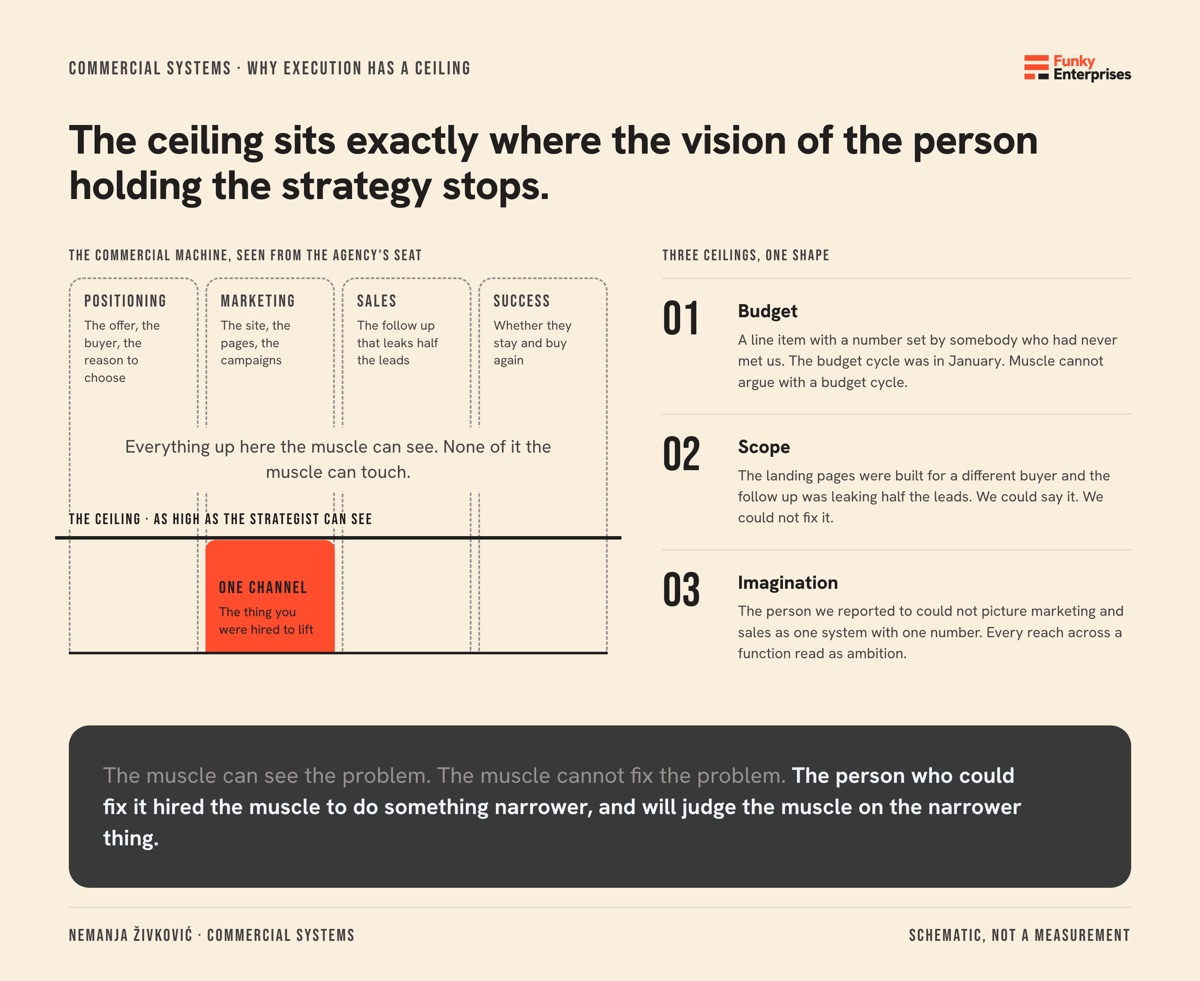
The agency I started in 2020 was built to be hired for the thing you could point at. Ads, a brand refresh, copy for a site. Somebody had already decided what they needed, and we could do it faster and cleaner than the person they had in-house. It was a good business. It was also a business that could never grow past the ceiling of whoever hired us, and that took me longer to admit than it should have.
Agency owners in the US, in Germany and here at home all describe the same complaint to me, and they almost always file it under pricing or bad clients. I think it sits somewhere less comfortable, in what you are being hired to be.
What it means to be the muscle
A company that hires you for ads, brand or copy is hiring an output with a shape they already know. A campaign, a deck, a set of pages. Their picture of what good looks like was formed before you walked in, usually by the person who owns the budget, and your job is to match that picture or beat it slightly.
You lift what you are told to lift. If you are strong you lift it well, the person who pointed at it is pleased, and next quarter they point at it again.
Muscle is valuable, and most of the agencies I respect are extraordinary at it. Some clients need nothing else because they already have someone inside who sees far and only lacks hands. If that is your client, you are in a good place. The trouble starts when the person doing the seeing can't see very far, because then your strength is capped by their eyesight.
Where the ceiling actually sits
I watched this on my own accounts for years before I saw the pattern. A client would hire us for Google Ads, we would run them well, cost per lead would come down and volume would go up. Then, somewhere around month eight, we would hit a wall that no bidding strategy could move.
The wall was always in the business around the account. The site converted at a rate that made the channel expensive at any scale, sales took four days to call a lead back, or the offer was priced against competitors buyers weren't even comparing it to. The person who hired us owned none of those things and could see few of them, because their job was marketing and those were other people's jobs.
So we would report the wall honestly, the client would nod, and nothing would change. Results would flatten and the relationship would end with everyone a little disappointed, because from where they sat the ads had stopped working.
Three ceilings
In hindsight the ceiling came in three forms, and most agency owners will recognise at least one.
The budget ceiling. The person who hired us owned a line item with a number set by somebody who had never met us. We could show a return that justified doubling it and still hear that the budget cycle opens in January. Muscle can't argue with a budget cycle. Somebody at the table where the cycle gets set can.
The scope ceiling. We could see that paid search underperformed because the landing pages were built for a different buyer and sales follow-up was leaking half the leads. We said so. We couldn't fix it, because we were hired for ads, the pages belonged to another vendor and the sales process to another director. Everyone agreed with the diagnosis and nobody had the mandate to act on all of it.
The imagination ceiling hurt the most. Sometimes the person we reported to simply couldn't picture a company where marketing and sales were one system with one number. They came up through one function and thought in it, so every proposal that crossed into another function sounded like an agency padding its invoice. Sometimes that was true, to be fair. Mostly it was us reaching for the thing that was actually broken, and the reach got read as ambition.
All three have the same shape. The muscle sees the problem and can't fix it, and the person who could fix it hired the muscle for something narrower and will judge it on that.
Why we moved
A few years in I stopped selling outputs and started selling the system: positioning, marketing, sales and customer success as one commercial machine with one number at the end. I stopped calling it marketing because half of what we fix lives in sales.
It cost us. Most of the clients who wanted muscle left, because the pitch went from "we'll run your ads better" to "the ads are probably the wrong first question", and plenty of people don't want to hear that once they've decided what they need. It cost us easy inbound too, since nobody types "commercial system" into Google. And it cost us the likes. Nobody shares a post about a rebuilt sales process, and the work stays invisible even when it works, because the client sees a business that grew and never sees the plumbing.
What we got back was the ceiling. When the engagement starts with the founder and the mandate covers the site, the offer, the sales follow-up and the channel, the wall we used to hit in month eight becomes the thing we fix in month two. The ads still get run, inside a machine that can absorb what they produce.
The claim is narrow and I'd like to keep it that way. Execution has a ceiling set by whoever holds the strategy. If you want your execution to be worth more, you have to move to where the strategy is held, which means a different seat, a different table and a different buyer.
The American version
The US is where most of my attention goes this year, and the pattern is louder there. The agencies I've looked at closely mostly pitch an output: paid social, performance creative, brand, content at scale. Production quality and speed are often better than anything I'd try to match. The ceiling is still the client's marketing lead.
What changes is the price of the wall. Budgets are bigger, so month eight is a bigger wall and the disappointment on both sides scales with it. The failed agency stories I hear from founders there are mostly the scope ceiling in a different costume.
That is also why a firm from Novi Sad gets a conversation with an American founder that the local shop doesn't. We'd lose a contest on muscle, so we don't enter it. We offer the seat that sees the whole machine and points the muscle at the right wall, and in a market where nearly everyone sells outputs, that seat is easy to notice.
If you are the muscle
I have this conversation often, usually with someone who runs a good agency and just lost a client they did everything right for.
They did do it right, within the mandate they had. The mandate was too small for the problem and they had no seat from which to change it.
From there I see two ways out. One is to accept the ceiling and price for it: be the best muscle in your category, work for clients whose strategy person really sees far, and let the others go early instead of in month eight. That's a real business, and some agencies I admire chose it on purpose.
The other is to move to the seat where strategy is held. You sell to the founder or the CEO, your first deliverable is a diagnosis of the whole commercial machine, and you say out loud that ads are probably the wrong first question, knowing you'll lose the clients who only wanted ads.
I took the second road and it wasn't clean. For a while the client list was smaller and the pitch took more calls to land. The clients we have now came in at the founder level with a mandate over the whole machine, and month eight stopped being where things end.
If you run an agency, or hire one, and this sounded like your last year, forward it to the person on the other side of that table. That conversation is usually where the ceiling starts to move. And if somebody sent you this, the Tuesday issue is free and lands once a week.
Written by
Nemanja Živković, Strategy Director and Founding Partner at Funky Enterprises. He builds commercial systems for B2B companies: positioning, marketing, sales and customer success working as one. More about Nemanja · nemanjazivkovic.co
Also published in the Commercial Systems newsletter. Read it on Substack