Nemanja Živković, Strategy Director, Founding Partner · 22 September 2026
The Broken Number Is Rarely Where It Shows Up
Why almost no company audits its whole commercial system, why the numbers to do it are usually missing, and exactly what we look at in three weeks.
In the first year of Funky Marketing, forty-seven companies came to us through LinkedIn without a single outbound message. Most of them asked for the same thing. Do for us what you do for yourself.
So we did. Profiles, posts, a content rhythm, and within a few months the attention was there. Comments from the right people, profile visits from the right companies, meetings on the calendar. And then, in more of those companies than I like to admit, nothing. The meeting happened and the deal died. Sometimes in a proposal that took three weeks to write. Sometimes on a sales call where the story the founder told was a different story from the one on the website. Sometimes six months later, when the customer who did sign quietly left and nobody noticed until the renewal date passed.
I was being paid for the LinkedIn, and the LinkedIn was working. The number that was broken lived somewhere I was not looking, and nobody had asked me to look there.
That is the whole reason the 360 audit exists. I want to explain what it is, in more detail than we usually put in front of anyone, because the thinking behind it matters more than the offer.
The number is broken somewhere else
Here is the pattern I have seen in more than a hundred B2B companies since. A metric goes red. Cost per lead climbs, or the pipeline goes flat, or the new product does not land. Leadership looks at the channel where the red number appears and calls a vendor for that channel. The ads person audits the ads. The SEO person audits the site. The LinkedIn person audits the profiles.
Each of them writes a competent report. Click-through rate is low here, this keyword is wasted, the headline could be stronger. All true. And the number stays red, because the click-through rate was low because the offer on the landing page was aimed at a buyer the sales team stopped selling to a year ago, after the pricing changed, after the best customers turned out to be a different segment than the one on the homepage.
A broken number is almost never caused by the channel it shows up in. It is caused by a gap between layers. Positioning says one thing, marketing says a slightly different thing, sales says a third thing on the call, and the customers who stay would describe the company in a fourth way if anyone asked them. Every layer looks fine on its own dashboard. The money leaks in the seams.
Basketball has the same problem with box scores. A player drops twenty-eight points and the team loses by fifteen, and everyone in the bar has an opinion about that player. The coach watching the tape the next morning is looking at something else entirely. Who was late on the rotation, who did not set the screen, why the ball stopped moving in the third quarter. The box score is the symptom report. The tape is the diagnosis.
Why companies do not do this
I have asked founders this directly, and the answers cluster into four.
The first is that nobody sells it to them. Every vendor who calls sells a channel, because that is what the vendor delivers. An ads agency will never audit your sales handoff, because there is no ads retainer at the end of that finding. The market is full of symptom reports because symptom reports lead to channel contracts.
The second is that nobody inside owns the whole system. I wrote last week about how marketing gave away three of the four Ps and kept promotion. The same thing happened one level up. Marketing owns the top, sales owns the middle, customer success owns the bottom, finance owns the price, and the founder owns the story. Four people, four dashboards, four definitions of a good quarter. An audit of the whole thing has no natural sponsor, so it does not get commissioned.
The third is that an audit feels like an admission. Ordering one says, out loud, that leadership cannot see why the engine underperforms. Founders who built the company from nothing find that hard to say. So they name a symptom themselves, “our SEO is weak,” and spend a year fixing it. I have watched a company spend twelve months and a serious budget on search when the actual constraint was that the two people who took the inbound calls were describing the product differently.
The fourth is the one I have the most sympathy for. They think they already know. “We know our problems.” Usually they know a problem. It is rarely the constraint. The constraint is the one thing that, if it moved, would move everything downstream, and it is almost never the thing that is loudest in the Monday meeting.
Why they do not have the numbers
Even when a company decides to look at the whole system, it runs into the second wall. The numbers to do it do not exist.
Last week I walked through a firm that ran a thirty percent margin until we divided by price instead of cost and it became seventeen. That is one missing number. Here are the ones I ask for on the first call of an audit, and how often the answer is a shrug.
Conversion between pipeline stages. Most CRMs can produce it. Most companies have never looked, because the stages were set up by whoever configured the tool three years ago and half the deals skip stages anyway. What they have is a closed-won number and a feeling.
Cost of a delivered day, or a delivered unit, including the unpaid work that won it. Covered last week. Almost nobody has it.
Time from first touch to signed contract, by segment. They know the average. They do not know that the enterprise deals take four months and the mid-market deals take three weeks, which means the two should have never been in the same funnel or the same forecast.
Churn they are not measuring. A services company that loses a client at the end of a project does not call it churn. A SaaS company that loses a seat inside a customer that stays does not call it churn. Both are churn. Neither shows up.
What customers actually value. There are three ways to know this. Ask them, read the support tickets, or watch which customers expand. Most companies do none of the three and write the homepage from the founder’s memory of why they started.
The reason these numbers are missing is structural. Each one sits across two departments. Conversion between stages sits between marketing and sales. Delivered day cost sits between delivery and finance. Churn sits between sales and customer success. Nobody’s job description covers the seam, so the seam has no number.
And this matters for the audit itself. When the data is missing, that is a finding. It usually explains part of the problem. A company that cannot tell you its stage conversion is a company where marketing and sales have never had to agree on what a qualified conversation is.
What we actually look at
So here is the audit, layer by layer. Four layers, each one scored, and then the gaps between them, which is where the money is.
Positioning and market. How clearly the company is positioned against the alternatives a buyer actually considers, and whether the market agrees. I say “actually considers” because the competitive set the founder names and the one the buyer shortlists are usually different lists. We look at the ideal customer as defined versus who is actually being sold to. We look for a defended point of view, meaning something the company would argue for in public, as opposed to a feature list with adjectives. And we look at whether the pricing and packaging send the same signal as the value promised. A premium promise with a price sheet that looks like everyone else’s is a positioning problem, and it shows up later as a discount problem in sales.
Marketing and demand. The full public footprint. The website, the executive presence on LinkedIn, the content, search, and increasingly what the AI assistants say when someone asks about the category. Paid channels when access is granted, for structure, waste, and whether the message matches the market. The split between capturing demand that already exists and creating demand that does not, and whether the message is consistent across both. And the path by which a stranger becomes a known, tracked lead, step by step, because that path leaks at every handoff and most companies have never walked it as a buyer would.
Sales and pipeline. The commercial motion from first touch to closed deal. Stages, handoffs, speed. Whether marketing and sales are aimed at the same buyer with the same story, which sounds obvious and fails constantly. Pipeline hygiene and conversion between stages, and, honestly, what the data can and cannot tell us. Then the outbound and referral motion, which in most companies is one of three things: present, absent, or accidental. Accidental is the most common. Referrals come in, nobody knows why, nothing is done to cause more.
Customer success and retention. Onboarding, retention, expansion, and the churn the company is not measuring. Whether happy customers turn into proof, referrals and case studies, or go quiet. And the loop back to the top: what customers actually value versus what the company is selling. This last one is the layer most audits skip entirely, and it is where the best positioning insight usually lives. Your retained customers already know why you are worth it. They just have not been asked.
The scope rule is simple. If it is public, we read it. If you grant access, we get inside it. If it touches how you win, keep, or grow a customer, it is in scope.
How it runs, in three weeks
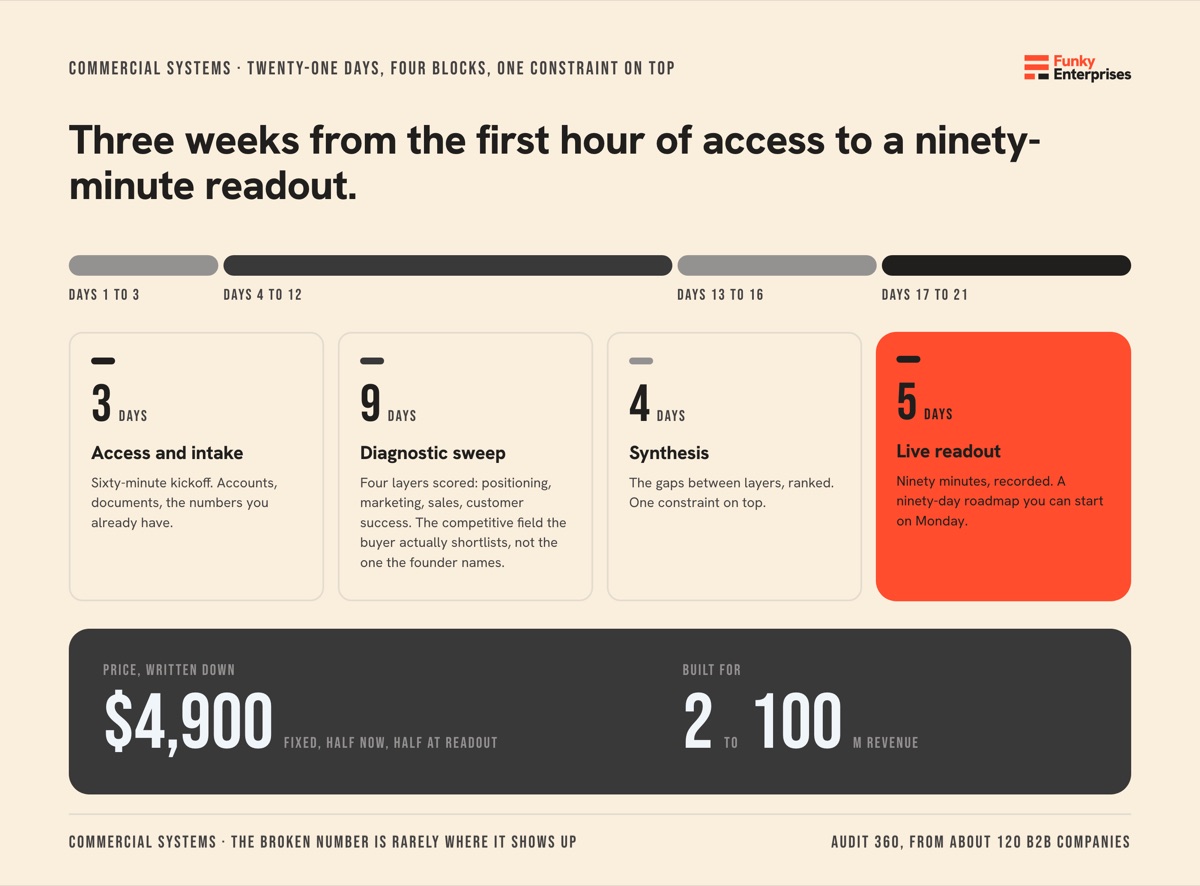
Fixed process, four steps, from kickoff to readout in about three weeks. I am firm on the fixed part. Open-ended discovery is how audits drift into a second month and a fourth invoice.
Days one to three, access and intake. A sixty-minute kickoff and an access checklist. We collect what is public and whatever the company chooses to share, analytics, ad accounts, CRM exports, sales decks. No access is fine. We audit what we can see and flag the blind spots created by what we cannot, and the blind spots go in the report as findings.
Days four to twelve, the diagnostic sweep. All four layers, scored, plus a map of the competitive field. This is the part where the lens does the work, the same one we have run across a hundred and twenty B2B companies in Europe, North America and the Middle East. Three weeks is enough because the lens is not new each time.
Days thirteen to sixteen, synthesis. This is where symptoms get separated from causes and every finding gets ranked by impact against effort. The output is a prioritized path, one constraint at the top, everything else in order behind it. A list of forty problems is a way of avoiding a decision.
Days seventeen to twenty-one, the live readout. Ninety minutes with the leadership team. We walk the findings, defend the priorities, take the pushback, and leave a ninety-day roadmap that the company can run with us or without us. The session is recorded, because the person who argued hardest in the room is the one who will need to rewatch it.
What lands on your desk
A scorecard with all four layers scored and the single biggest constraint named. One constraint, not a ranking of everything. The full diagnostic report with findings, the evidence behind each, and the causes behind the symptoms. A competitive read, meaning where you stand against the alternatives buyers actually shortlist, which is a different document from the one your sales team has in its head. The ninety-day roadmap, sequenced by impact and effort, with owners. The recorded readout. And a quick-win list, the things to fix in the first two weeks before anything structural starts, because momentum matters and some findings are just a broken form.
The price, and why it is written down
The 360 Commercial System Audit has a fixed fee and a fixed scope, and takes about three weeks. The fee is set in the currency of the client's market, and we say it on the first call, not after the third meeting. Paid in full at kickoff, or half at kickoff and half at the readout. No retainer required to start, no long form to sign.
There is one more rule, and it is the one that makes the price make sense. If the company engages us on an ongoing basis within thirty days of the readout, the full fee is credited against the first invoice. So the audit either stands alone as a paid roadmap, or it becomes the front door to the work and costs nothing. The incentive that creates for us is worth saying out loud. We get paid to be right, because a vague audit converts into nothing.
What it does not include: ad spend, tools and subscriptions, which stay in your accounts. Execution of the roadmap, which is a separate and optional engagement. And net-new data collection where no history exists. We flag what is missing. We do not invent it.
Who this is for, and who it is not
It fits a B2B company somewhere between two and a hundred million in revenue, selling across borders, with a founder, CEO, CRO, CMO or head of growth who owns the revenue number and is willing to hear that the constraint is somewhere they did not expect. Tech, SaaS, AI, data, and B2B services are where the lens has the most reps.
It does not fit a company that wants a second opinion on the ads. There are cheaper people for that and they will do a fine job. It also does not fit a company that has already decided what the problem is and wants a document that agrees. We will look, and the readout will say what we found.
The moments it usually gets ordered: spend is up and results are flat. A new market or product is not landing. A funding round, a new revenue leader, or a board that has started asking pointed questions about growth. A rebrand in progress, or messaging that has changed three times this year. Or an agency was just fired and the founder has a quiet suspicion that the agency was not the problem.
The part I keep coming back to
The founder I worked with on the margin sheet last week had every channel working and was earning half what they thought. The companies from that first Funky year had LinkedIn working and were losing deals on calls I never heard. In both cases someone had bought a channel audit at some point and it came back clean.
The point guard analogy from last week holds here too. The channel is the scorer. The commercial system is the whole offence, and a coach who only reviews the scorer’s tape will keep losing games by fifteen while the scorer keeps dropping twenty-eight.
If you run a company, or the revenue number in one, here is the question I would sit with. When the last red number showed up on your dashboard, who did you call, and did they have any reason to look outside their own channel?
If the honest answer is no, the audit is the door we hold open. Details and the kickoff calendar are at funky.enterprises. And if you have run something like this internally, I would genuinely like to hear which layer the constraint turned up in. My running count says it is almost never the one the company expected.
Written by
Nemanja Živković, Strategy Director and Founding Partner at Funky Enterprises. He builds commercial systems for B2B companies: positioning, marketing, sales and customer success working as one. More about Nemanja · nemanjazivkovic.co
Also published in the Commercial Systems newsletter. Read it on Substack