Nemanja Živković, Strategy Director, Founding Partner · 30 October 2026
The Attribution Leak: Four Won Deals My Dashboard Never Saw
Our own sales log was missing four won deals. When we found them and asked where they came from, the answer disagreed with every dashboard we own. Here is why the dashboard loses.
In June I sat down to run the quarterly check on my own company that I run on every client. Where did demand come from, how much of it turned into work, what does the mix look like compared with last quarter. The check reads from a sales log that our pipeline fills automatically from the booking calendar, and the log said one inquiry and zero won deals for the quarter.
That was wrong, and I knew it was wrong, because I had signed a twelve-month contract three weeks earlier and it was sitting in the Drive folder with both signatures on it. So I did what I tell clients to do and never enjoy doing myself: I went through the mailboxes, the proposals folder, and the invoices, one by one, and reconciled them against the log.
The real number for the quarter was around eight inquiries and one signed engagement, with three more from earlier in the year that had never been entered as won either. Four won deals, missing from the system that was supposed to tell me how my company gets clients. The log said three won all year. The truth was seven.
I want to tell you what was in those four rows once we filled them in, because the interesting part is the column that says where each one came from, and because that column is the reason I no longer trust any attribution dashboard, including mine, without asking a human first.
The four rows
Each won deal in our log gets a source. Where did the first contact come from, as far as we can honestly tell. When I backfilled the four missing ones, I did it from memory and from the email threads, and I did not guess any of them.
One was a referral. Somebody who had worked with us told a founder to call us.
One was a referral through a partner, a large company we had a relationship with, whose team pointed a prospect at us.
One came from my weekly column in a business paper. The founder had been reading it, wrote in, and mentioned the column in the first line.
One came from a masterclass. Somebody who sat in the room a year earlier came back when they had a budget.
Now look at what is missing from that list. None of the four came through search or through an ad, and none of them, as far as the first contact goes, came through a form on our website that a piece of software could have attributed to anything. Two referrals, one column, one room. If you had asked our analytics where those clients came from, it would have told you Direct, or Organic Search, because at some point each of those people typed our name into a search box or into the address bar, and that is where the software picked them up.
The software was answering honestly. It was just answering a different question from the one I was asking.
Two questions that sound the same
There are two questions hiding inside “where did this client come from”, and most companies collapse them into one because the dashboard only answers one of them.
The first question is: what did this person click last before they filled in the form? That is a capture question. It tells you which door they walked through. Software answers it well, because software sees the click.
The second question is: why did this person know to look for us at all? That is a creation question. It tells you what built the intent that the door then captured. Software answers it badly or not at all, because the moment the intent was created usually did not involve a click on anything we own. It happened in a conversation, or in a feed, or in a room, or in a column somebody read on a Saturday.
We have both answers for our own company, and I want to put them next to each other because the gap is the whole point.
What the software says
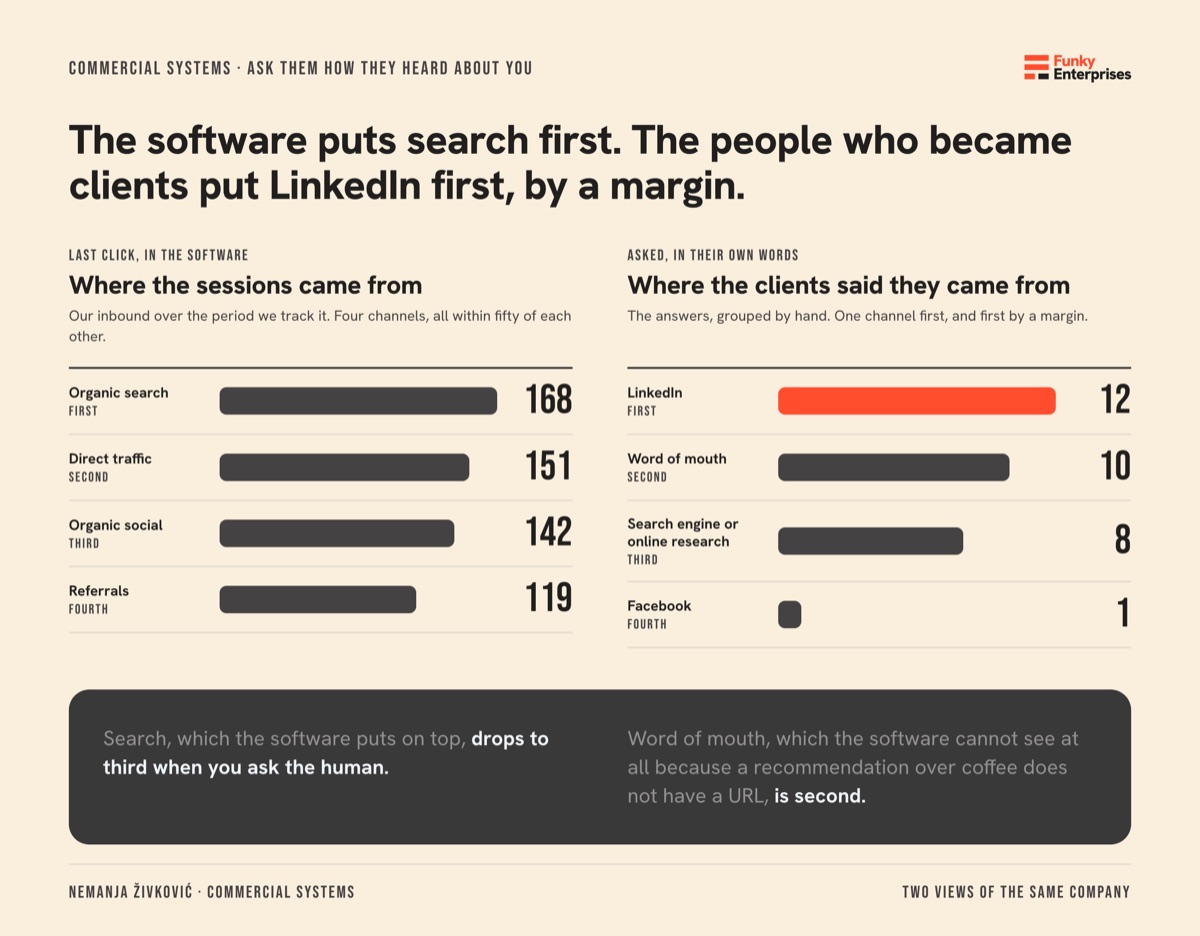
The last-click view of our inbound over the period we track it looks like this. Organic search, 168. Direct traffic, 151. Organic social, 142. Referrals, 119.
That is a reasonable looking spread. If you were the marketing manager reading it, you would conclude that search is our biggest channel, that we have a healthy amount of direct brand traffic, that social is doing fine and referrals are a solid fourth. You would probably put more into SEO. You might wonder what “direct” means and decide it was people who already knew us, which is true, and then not ask the next question, which is how they came to know us.
What people say
For years we have had a field on our inbound form that asks one plain question: how did you hear about us? Free text. No dropdown, because a dropdown tells people what the acceptable answers are and I wanted the unacceptable ones.
When I went through the answers and grouped them, the count came out like this. LinkedIn, 12. Word of mouth, 10. Search engine or online research, 8. Facebook, 1.
Read those two lists again. In the software, organic social is third. In the words of the people who actually became clients, LinkedIn is first, and it is first by a margin. Search, which the software puts on top, drops to third when you ask the human. And word of mouth, which the software cannot see at all because a recommendation over coffee does not have a URL, is second.
Both lists measure the same company, the same inbound, from the same period, and the only difference between them is who you asked. The software, or the person.
What the free text told me that the count could not
I want to share a few of the answers as they were written, with nothing identifying, because the wording carries information the count flattens.
A marketing director at a software company wrote: “I got Nemanja’d on LinkedIn.” Another wrote that I jump out of the page on LinkedIn. A founder in an industrial business wrote that they came through my LinkedIn, and then added a sentence that I have thought about more than any dashboard: they said the marketers they meet in their industry are generally mediocre and unoriginal, and we seemed to think differently.
A chief product officer wrote that they follow me and my message resonated with where their marketing was. A chief executive wrote that they had been reading the posts and were looking to build a profitable and scalable inbound strategy, and named a monthly budget in the same sentence. A founder wrote that some of the content they had seen matched how they thought about their own startup, so why not start a conversation.
Every one of those people arrived at our form after typing something into a search box or an address bar. Every one of them would be Direct or Organic Search in the software. And every one of them, when asked, said the same thing in different words: I had been reading you for a while, and then I decided.
There is a version of this that goes further than the form. On a first call, someone at one of the largest software companies in the world told me they had been reading my posts for five years before reaching out. Five years. There is no attribution window in any tool that goes back five years, and if there were, it would credit a single post from 2021 and miss the other four years and eleven months.
Why the dashboard loses
I want to be precise about why I say the dashboard loses, because it is a strong claim and performance people will push back on it.
Last-click attribution gives the credit to the final touch before conversion. For a company like ours, and for most B2B companies with a considered purchase, the final touch is almost always a branded search or a direct visit, because by the time somebody has decided to talk to you, they know your name. So last-click systematically credits the end of the path and cannot see the beginning. It rewards the door and ignores whatever brought the person to the street.
That would be a harmless quirk if people did not make budget decisions from it. But they do. The marketing manager reading our software numbers would fund search. The founder reading our human numbers would fund LinkedIn and the column and the rooms, and would be right, because that is where the intent gets made. Two people reading two views of the same company would spend money in opposite directions, and only one of them would be spending it where the clients say they came from.
I hold this as a rule now, for my company and for every client: last-click is a caveat, not a benchmark. You read it to know which doors are working. You do not read it to decide where to build.
The part that was my fault
I said the log was missing four won deals, and I want to be honest about why, because the reason is more common than the fix.
The log was automated. It read from the booking calendar, and it did that job fine. But the deals that actually closed did not come through the booking calendar. They came through a referral email to one mailbox, a partner introduction to another, a reply to a column that landed in a third. Four mailboxes, and the automation was reading one. The system was measuring the front door while the clients were coming in through the side, the back, and a window somebody had left open.
So the sales log was undercounting in a specific direction. The channels it could see were the low-intent ones, the cold calendar bookings, the form fills. The channels it could not see were the warm ones, where somebody who already trusted us wrote to a human. Which meant that every quarterly report I had run on my own company was telling me, quietly, that we had a demand problem, when what we had was a logging problem and a strong brand.
Once I saw that, the fix turned out to be a person rather than a better dashboard. Every month, somebody now walks the mailboxes, the proposals folder and the invoices, and reconciles them against the log by hand, and every won row gets a source that a human wrote down after asking. The automation still runs. It is no longer trusted alone.
What this means if you run a company
If you take one thing from this, take the question. Put it on your form, free text, no dropdown: how did you hear about us? Then read the answers yourself, every one, at least once a quarter. Do not have anyone summarise them for you. The count matters, but the sentences matter more, because the sentences tell you what the count means.
Second, run the reconciliation I ran. Take the last ten deals you actually signed. Ignore what the software says. Go to the first email, the first message, the first call, and write down what actually brought that person to you. Then put that list next to your attribution report and see if they agree. In my experience they will not, and the direction of the disagreement will tell you exactly which of your channels is being underfunded.
Third, treat “direct” as an echo. Direct traffic is what your ads, your posts, your column, your referrals sound like a week later, when the person finally types the name. A company with a lot of direct traffic and no idea why has a brand it is not measuring. A company that reads direct as a free channel and cuts the things that produce it will watch direct fall three months later and not understand what happened.
There is a way of reading a funk record that I learned long before I learned marketing. The sleeve credits the singer, and the singer is the reason the record has a name. But the reason you bought it, the reason you played it until the groove wore down, is the bass line and the drummer, and their names are in small print on the back, if they are there at all. Nobody walks into a record shop asking for the bass player. Attribution software is the sleeve. It credits the singer, the thing that had the name on it at the moment of sale. The client who says “I had been reading you for a year” is telling you who was playing the bass.
We are not going to stop measuring. The software numbers are real and the doors matter. But I have stopped letting the software have the last word on where our clients come from, because when I finally asked the clients, they gave a different answer, and it was the one I should have been building around all along.
One question, and it is the same one I put on the form. For the last client you signed, how did they actually hear about you, and does the tool you pay for know?
Written by
Nemanja Živković, Strategy Director and Founding Partner at Funky Enterprises. He builds commercial systems for B2B companies: positioning, marketing, sales and customer success working as one. More about Nemanja · nemanjazivkovic.co
Also published in the Commercial Systems newsletter. Read it on Substack