Nemanja Živković, Strategy Director, Founding Partner · 29 September 2026
Who Owns the Seam
Every company has a number that sits between marketing and sales. In most of them it is nobody’s job to look at it. Three companies where it went wrong, and the one thing all three had in common.
A pair of Jordans almost never dies on the leather. The upper is fine, the sole is fine, and one day the two come apart at the stitching, and you are standing in the rain with a shoe that has a mouth. The person who cut the leather did their job. The person who moulded the sole did their job. The shoe failed where their two jobs met, and there was no third person whose job was the seam.
I have now written two pieces on this newsletter about the seams in a company’s commercial system, and every time I walk a founder through the audit the same question comes back at the same point. Fine, the money leaks between marketing and sales. Whose job is that?
I want to answer it properly, with three companies I have worked with, because the answer is shorter than people expect and harder to do than it sounds.
What the seam number actually is
Every department has numbers it can produce alone. Marketing has visitors, followers, form fills, cost per lead. Sales has meetings, proposals, closed deals, average contract. Customer success has renewals and tickets. Each of these lives in one system, is owned by one person, and shows up in one Monday report.
The seam number is the one you cannot compute without both sides. How many of the conversations marketing produced did sales actually accept as worth their time. How long the gap was between the form and the first call. How many of the people who asked for a demo were ever going to be a customer, judged by the sales team’s own definition, not marketing’s. And, running in the other direction, whether what sales says on the call is what marketing says on the site.
None of these can be pulled from one dashboard. They need marketing’s data and sales’ judgement in the same sheet, and they need the two teams to agree on what a conversation worth having looks like. That is the first place it breaks, because in most companies the two teams have never been made to agree on that, so each one keeps its own number and both numbers look fine.
Scene one: the number that was reported and never used
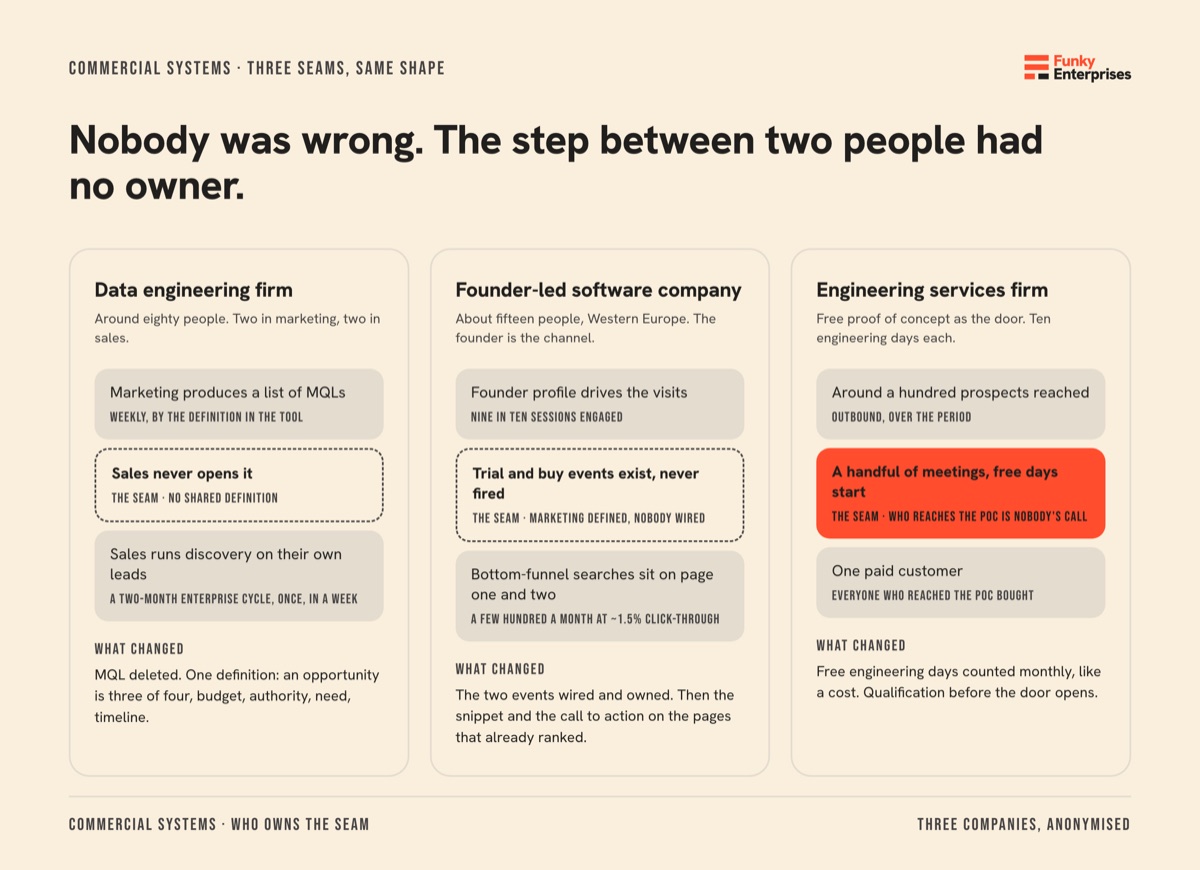
A data engineering company, around eighty people, serious engineering, a marketing team of two and a sales team of two. We worked with them on positioning and go-to-market for a good stretch a while back, and part of the work was rebuilding how they measured marketing.
Marketing had a number. Marketing qualified leads, the classic one, counted every month, up and to the right on the slide. Somebody filled a form, downloaded something, attended a webinar, hit a score, and became an MQL. The number was real and the team was proud of it.
Sales did not use it. When I sat with the two salespeople and asked them where their conversations came from, they named referrals, a conference, a founder’s old relationship, a message on LinkedIn. Not one of them said the list. The list was going out every week and the people receiving it had, politely and for a long time, been treating it as noise.
Nobody was lying. Marketing had defined a qualified lead the way marketing tools define it, by behaviour on the site. Sales defined a good conversation the way salespeople do, by whether there was budget, a person who could sign, a real need, and a reason to do it this quarter. Both definitions were sensible. They just described different people, and the seam number, the share of marketing’s list that sales would actually have accepted, was close to zero and had never been calculated, because computing it would have required the two teams to argue it out.
So the first thing we did in the measurement work was delete the MQL from their dashboard. In its place went one shared definition of an opportunity: a conversation that clears three of four questions, budget, authority, need and timeline, judged by whoever had the conversation. Marketing got credit for opportunities it sourced, not for forms. The number on the slide got a lot smaller and, for the first time, sales looked at it.
One more detail from that company, because it matters for the question of who owns this. One of the two salespeople was excellent. A large enterprise discovery that normally took two months, they ran in a week. Their instinct for which conversations to chase was the best in the building. The MQL list had been going to them too, and they had been ignoring it like everyone else. The company had its best judgement about what a good conversation looks like sitting in one person’s head and its official definition sitting in a marketing tool, and the two had never met.
Scene two: the event that existed and was empty
A software company in Western Europe, about fifteen people, founder-led, selling a technical tool that engineers try before they buy. The whole business ran through a trial. Somebody finds the product, clicks trial, uses it, buys or does not.
The founder cared about exactly one thing, and told me so on the first call: sales. Which I respect, and which made the next finding awkward.
When we opened their analytics, the trial click and the buy click were set up as key events. They had names. They had been created by someone, at some point, with the right intention. They had never fired. Whoever set them up had not connected them to the actual buttons, nobody had noticed, and the company had been running for years on a site where the two clicks that make the whole business work were invisible.
Meanwhile the founder’s personal LinkedIn was doing well. More sessions from the founder’s profile than from the company page, about nine in ten of those sessions engaged, people reading for minutes. Awareness, in other words, worked. And the bridge from that attention to the trial was unmeasured, so nobody knew whether those readers ever clicked, and nobody could have known.
Once the events were wired, the picture was ordinary and fixable. A few hundred bottom-of-funnel searches, the “convert this to that” queries where the buyer already knows what they need, were ranking on the first and second page with a click-through rate around one and a half percent. The work was on the pages that already ranked: the snippet and the call to action. The founder had been told for years, by people selling content, that the company needed more content.
Here is the seam in that company. Marketing was the founder, in the evenings, on LinkedIn. Sales was a trial page and a pricing page. There was no department on either side to argue with, and that turned out to be the same problem as the eighty-person company in a different costume. Nobody’s job was the step between attention and trial, so the number for that step did not exist, so an empty event sat there for years and looked like a number.
Scene three: everyone who got to the meeting bought
The engineering services firm from the margin piece, the one that thought it ran a thirty percent margin. I will not repeat the whole story. The part that belongs here is the funnel.
When we lined up a year of prospects, everyone who had made it to a first meeting had converted. The scoping workshop and the proof of concept, once a prospect was in them, worked every time. Just over a hundred companies reached, a handful of meetings, one paid customer.
So the entire problem lived between “reached” and “meeting”. And that step had a curious status inside the company. The days spent on it, the workshop, the proof of concept, the proposal, were called sales support. They were done by engineers, reported nowhere, budgeted nowhere, and owned by the founder, who also owned the story, the pricing and the delivery. When one person owns everything, the seam has no owner, because the seam only becomes visible when someone is measured on it and nothing else.
What changed there was a rule that the free days count as days, a number that the founder now looks at monthly, the real conversion off the free door, and a marketing job that was redefined as one thing: get the right company into one conversation. The seam got a number and a person, and the person was the founder, but now explicitly, for that number, with the free days on the same sheet as the paid ones.
What the three had in common
Different sizes, different countries, different products. In all three the seam number had a name in one department’s vocabulary and no owner in the company.
At the eighty-person company it was called MQL and belonged to marketing, which is why sales ignored it. At the fifteen-person company it was called a key event and belonged to whoever had once set up the analytics, which is why it was empty. At the engineering firm it was called sales support and belonged to nobody’s budget, which is why the founder was earning half of what they thought.
And in all three the fix started the same way. Two sides sat down and agreed, in writing, on what a conversation worth having looks like. Then one number was built on that definition. Then one person was told it was theirs.
I wrote a longer piece on LinkedIn back in May about measuring marketing in six layers instead of one, and the very first move in it was to kill the MQL. Every time I have done that with a company, the argument that follows, about what replaces it, is the most useful meeting the marketing and sales teams have had that year. The argument is the point. The definition that comes out of it is the seam number’s birth certificate.
So who owns it
Here is the answer, and I will defend it.
Under roughly a hundred people, the owner of the seam is whoever owns the revenue number. Usually the founder, sometimes a CEO or a chief revenue officer. By default that person already owns it, and by default nothing happens, so the ownership has to be explicit: the seam number named, on their weekly sheet, next to nothing else from either department. The reason it has to be that person is that fixing a seam almost always means changing both sides at once. The website says one thing and the sales deck says another, and the person who owns the seam has to be able to change both. A marketing lead cannot rewrite the sales script. A sales lead cannot rewrite the homepage. The founder can.
Above that size, one person is paid on the seam number and on nothing that belongs to either side. Titles vary. The thing to check is the bonus. If the person who owns the seam is bonused on pipeline generated, they are marketing with a different business card. If they are bonused on closed revenue, they are sales. The seam owner is measured on the conversion between the two, and on how long it takes, and on whether the story is the same on both ends. The moment their pay depends on it, the two teams finally have someone with a reason to make them agree.
And here is the trap that most companies fall into instead. They form a committee. A weekly marketing-and-sales alignment meeting, a shared Slack channel, a joint dashboard that both sides can read and neither side is measured on. I have sat in a lot of those meetings. They are pleasant, everyone is aligned, and the number does not move, because a meeting cannot be paid on a number. Alignment meetings are how a company avoids appointing an owner while feeling like it did.
The smallest version, which is what we do
We are a small shop, so I will tell you exactly what this looks like at Funky, because it is embarrassingly simple.
Every inquiry that comes in gets logged with its source. Calendly, a LinkedIn message, an email, a referral, a podcast, a speaking event, a comment. A conversation becomes an opportunity when it clears three of the four questions, and I am the one who judges it, because I am the one who had the conversation. Once a week I look at the ratio between the two, by source. That is the whole thing. It lives in a spreadsheet and it takes ten minutes on a Monday.
And I will tell you what it caught, because it caught me. The first time we reconciled that log against the invoices, four paying clients were missing from it. They had come in warm, through referrals and a column I write, and my logging habit had only been catching the people who booked a call through the site. Marketing’s numbers looked fine. Sales’ numbers looked fine. The owner of the seam, which was me, had been skipping the boring part, and the seam number was wrong by four deals.
In basketball, the pass before the shot is the one nobody on the stat sheet gets credit for. The seam number is that pass. Somebody has to be watching for it, or the team keeps losing by three and blaming the shooter.
One question, and you can answer it in a reply or just check it for yourself tomorrow morning. In your company, who can change both the homepage and the first sales call? If the honest answer is two different people who have never had to agree on what a good conversation looks like, you have found your seam, and it has no owner yet.
Written by
Nemanja Živković, Strategy Director and Founding Partner at Funky Enterprises. He builds commercial systems for B2B companies: positioning, marketing, sales and customer success working as one. More about Nemanja · nemanjazivkovic.co
Also published in the Commercial Systems newsletter. Read it on Substack