Nemanja Živković, Strategy Director, Founding Partner · 16 September 2026
Your 30% Margin Is Probably 17%
Pricing used to be a marketing job. Here is what happened when we took it back for one client, and why the spreadsheet mattered more than the website.
A few months ago I sat in a spreadsheet with the founder of an engineering services firm. Small team, serious people, the kind of shop that gets the hard technical work done and then wonders why the bank account does not reflect it.
The founder told me they run a thirty percent margin. Said it the way you say your shoe size. A known fact, not up for discussion.
By the end of the afternoon the sheet said seventeen.
Both numbers were true. They measured different things, and nobody had ever had a reason to put them side by side. That is the whole story, and I want to walk through it, because it is the most important piece of marketing work I did this year and it did not involve a single piece of content.
Why a marketing guy was in a margin spreadsheet at all
Three weeks ago I wrote on LinkedIn about who gets to set a price. In 2019 I put my prices on the website, three to ten thousand euros, and people from my own ecosystem asked me publicly who I was to charge that. The answer then and now is the same. I set the price, the proof comes after.
This is the part I skipped there, because a post cannot carry it. Setting the price is the easy half. Knowing what the price has to be, and what it does to the business when a prospect says yes, is the half most people never do.
Here is what bothers me. Pricing sits in the four Ps. Every marketing textbook since the sixties has it right next to product, place and promotion. And I cannot remember the last time I met a marketing lead who owned it. Somewhere along the way marketing became the promotion P and quietly handed the other three to product managers, finance and founders. We kept the part that gets likes and gave away the part that decides whether the company lives.
So when we started the engagement with this firm, positioning and a new website were on the brief. Offers, messaging, a homepage that finally says what they do. Normal work for us. But before any of that I asked for the cost per person-day, the utilisation, and the list of everything they sell with the days each one takes. You cannot write a homepage that sends people through the right door until you know which door makes money.
That is why we built the sheet before we built anything else. The website, the offers, the messaging, all of it was going to stand on those numbers, so the numbers had to be right first.
The three numbers that were never in the same room
The first number is what a person costs. Eighty thousand euros a year, fully loaded, divided by roughly two hundred and twenty-three working days once you take out weekends, holidays and leave. About three hundred and sixty euros a day. The founder had this one. Everybody has this one.
The second number is what a delivered day costs. An engineer does not bill eight hours out of eight. There is the internal call, the proposal for the next client, the certification renewal, the gap between projects. At seventy percent utilisation, the three hundred and sixty euro day costs about five hundred and fifteen once the non-billable time is carried. Nobody had this one, because nobody had ever asked how much of a day is actually a day.
The third number is the margin, and this is where it fell apart.
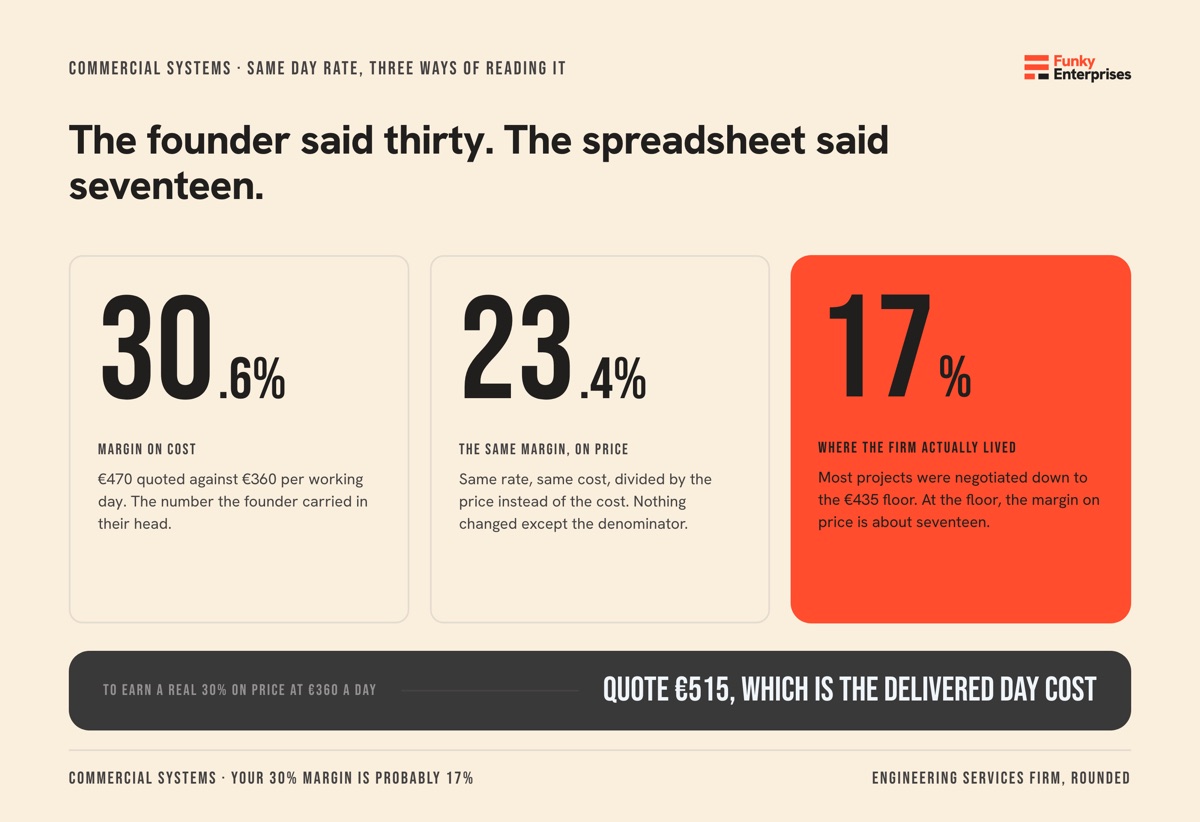
Their standard daily rate was four hundred and seventy euros. Against a cost of three hundred and sixty, that is a margin of thirty point six percent on cost. Or it is twenty-three point four percent on price. Same two numbers, two different margins, depending on which one you divide by. The founder had always divided by cost, which is how the thirty got into everyone’s head. Every customer and every competitor divides by price.
Then we set a floor. Four hundred and thirty-five euros a day is the minimum a day has to be sold for so the firm carries its overhead and its gaps. We wrote it down as a standing rule: take everything that will be paid for a piece of work, divide by the number of days the work takes, and if the answer is under four hundred and thirty-five, either the price or the scope is wrong.
At that floor the margin on price is about seventeen percent. To actually earn thirty on price, a day has to sell for five hundred and fifteen. Which, and this is the kind of coincidence that makes a spreadsheet worth building, is exactly the cost of a delivered day at seventy percent utilisation. The number the founder thought they were earning was the number they needed to charge just to break even on real days.
I cook a lot. When I grill for twenty people I know what a plate costs before anyone rings the bell, and I know it including the charcoal I burn getting the fire right, not just the meat. Most companies price the meat.
The free door
Like every services firm I have ever worked with, they do a lot of work before the first invoice. A scoping workshop. A small proof of concept so the prospect can see the team in action. A few senior days on the proposal. Nobody calls it a product, but it is one, and it has a price. We added it up per prospect and it came to about ten engineering days. Ten days at three hundred and sixty euros is three thousand six hundred euros spent on every company that gets that far, whether they buy or not.
Nobody had ever priced it. It was not on any offer sheet, because it was not an offer. It was just what you do to win work.
Then the question the whole business rests on. What conversion rate makes that unpaid work pay for itself?
The math is simple. Break-even conversion equals the cost of the unpaid work per prospect divided by the first-year gross margin of whatever the customer buys next. Their own figure for the year so far was just over a hundred companies reached and one paid conversion. Roughly one percent.
We ran the free door against every paid offer on their roster. If it converts into a one-off, an audit, a quick win, a training day, it needs a conversion rate somewhere north of forty percent to pay for itself. Nobody converts a free door at forty percent. If it converts into something that lasts, a twelve-month retainer or a large build project, the break-even drops to around eighteen percent. Still a long way from one, but a number a company can actually work towards.
So the free door is fine as a door. It just only pays when something recurring lives behind it. Which means every piece of marketing we build for them, every page and every email, has to aim the free door at the retainer and the large project and stop treating the one-off audits as the goal. The offer structure told us what the marketing had to say, before a single word was written.
The project that was quoted at 470 and delivered at 250
One more thing came out of the sheet, and it is the one I would tattoo on the wall of every services company.
We ran a finished project back through the model. A build project, around twenty-five thousand euros all in, a real customer, a good outcome, the kind of case study you put on the homepage. It had been quoted as if it would earn about four hundred and seventy euros a day.
It came out near two hundred and fifty.
The free days had never been counted as effort days. The workshop and the proof of concept that won the deal were ten days of engineering, and when the project was priced, those ten days simply did not exist. They were marketing. They were somewhere else. So the paid part looked healthy and the whole thing, from first hello to last invoice, sat well under the floor.
The customer was happy. The engineers were proud. The company earned about half of what it thought it earned. Nothing about that shows up in a case study.
The bottleneck was never delivery
There was one number that surprised the founder more than the seventeen. When we lined up every prospect from the year, everyone who had made it to a first meeting had converted. Every single one. The proof of concept, once someone was in it, worked.
The problem was getting to the meeting. A hundred reached, a handful of meetings, one paid.
For a marketing engagement that changes everything. The positioning and the website carry the entire load, because the only step that fails is the one they are responsible for. The whole engagement collapses into one job: get the right company into one conversation, then let the proof of concept do what it already does.
If I had not built the sheet first, we would have built a beautiful site that sold the wrong door to people who were never going to walk through it. And the founder would still be saying thirty.
The two numbers they watch now
We left them with a workbook, one standing rule, and two numbers to look at every month.
The real conversion rate off the free door. That tells you whether the bridge from free to paid works.
The achieved euros per day on every delivered project, counting the free days. That tells you whether the price is real once the work is done.
Everything else on the dashboard is a reach lever. Those two are the business.
So why does nobody in marketing do this anymore?
I keep coming back to it. Pricing is on our side of the textbook. Offer design is on our side of the textbook. The question of which door a prospect enters through and what it costs to hold that door open is a marketing question by any definition older than the internet. And I meet very few marketers who can tell me their company’s cost per delivered day, or what conversion rate the free trial needs to pay for itself, or whether the thirty percent margin on the slide is on cost or on price.
We got comfortable being the promotion department. A muscle. And a muscle is limited by how far the person running the strategy can see. When that person thinks thirty and the sheet says seventeen, no campaign fixes it.
Basketball has a version of this. The point guard never makes the highlight reel, but the whole offence falls apart without him. Pricing and offer economics are the point guard of a commercial system. Nobody shares them. Everything runs through them.
If you run marketing and you have never opened the margin sheet, open it. If your company does not have one, build it. Ask what a delivered day costs, not a person-day. Ask which margin is on the slide. Count the free days as days. Then decide what the homepage says.
One question, and you can answer it in a reply: the margin on your last board slide, was it on cost or on price? If you had to think about it, that is the answer.
And if you would like a second pair of eyes on where your own commercial system is leaking, the Commercial System Leak Audit is the door we hold open. Nine questions, five minutes, and you see an estimate in euros of what leaks each year, with no sign-up.
Written by
Nemanja Živković, Strategy Director and Founding Partner at Funky Enterprises. He builds commercial systems for B2B companies: positioning, marketing, sales and customer success working as one. More about Nemanja · nemanjazivkovic.co
Also published in the Commercial Systems newsletter. Read it on Substack