Nemanja Živković, Strategy Director, Founding Partner · 27 October 2026
Where Performance Stops
On the second of September I sat at a table with people who believe the right campaign fixes whatever is wrong. I used to be one of them. Three questions show where a campaign stops, and what it has been covering for.
On the second of September I was at a table with a former boss of mine and a group of people who run performance marketing for a living. Good people, sharp, the kind who can tell you the cost per lead of a campaign they ran three years ago to the decimal. The conversation drifted, as these conversations do, to a company one of them was working with, and somebody said that whatever the problem was, the right campaign would fix it.
Nobody disagreed. I did not either, out loud, for a reason I will get to. But I sat there with the feeling you get when you hear your own voice from ten years ago coming out of somebody else’s mouth, and you know exactly what they have not seen yet.
I was one of them. For a long stretch of my working life I believed that a well built campaign was the answer to almost any commercial question, and the ones it could not answer were somebody else’s department. I was good at it. It paid. And it took me a lot longer than it should have to see the line where performance stops, because the line is invisible from inside a campaign dashboard.
This piece is about that line. Where it is, why people who live in campaigns cannot see it, and what a company has to do on the far side of it that no amount of budget will do for them.
Why I did not argue
I want to be honest about the evening, because the honesty is part of the point.
The person hosting was already angry about something unrelated before the conversation started, and there is a rule I have learned the hard way: you do not open a second argument at a table where the first one has not finished. So I said nothing, drank my coffee, and listened to people I like describe a worldview I used to hold.
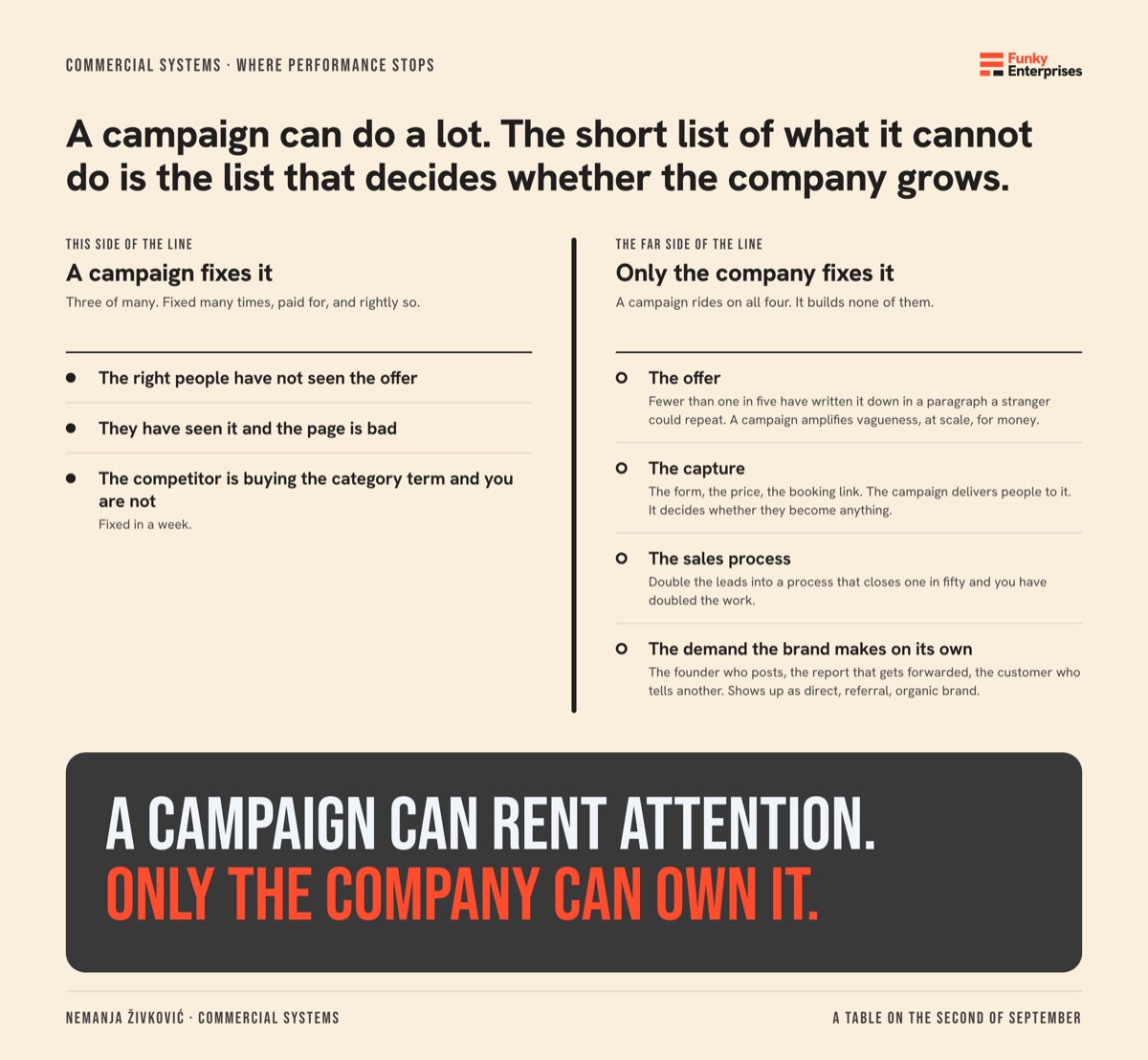
The other reason I did not argue is that they were not wrong about the thing they were talking about. A campaign can do a lot. If the problem is that the right people have not seen the offer, a campaign fixes that. If the problem is that they have seen it and the page is bad, a campaign with a better page fixes that. If the problem is that the competitor is buying the category term and you are not, a campaign fixes that in a week. The performance people at that table have fixed all of those problems many times and been paid for it, and their confidence was earned.
Where they were wrong is in the word “whatever”. The list of problems a campaign can fix is long. The list of problems it cannot fix is shorter, and it contains every problem that actually decides whether a company grows.
The line, drawn plainly
Here is where performance stops. A campaign moves people who are already close to a decision toward the decision, faster and in greater numbers than they would have moved on their own. That is the whole job, and it is a good job. It cannot make people want something they do not want. It cannot make an offer make sense if the offer does not make sense. It cannot make a sales process work that does not work. And it cannot, this is the one that matters most, replace the demand a brand should be creating on its own and is not.
Everything on the near side of that line is a campaign problem and a good performance team will solve it. Everything on the far side is a commercial problem, and the campaign will not solve it, and worse, the campaign will hide it, because the dashboard will show green while the company quietly fails to grow.
I have watched this happen enough times that I can describe the shape of it without naming anyone. Let me give you two examples from this year, both anonymised, both real.
The brand that does not buy its own demand
Earlier this year I prepared for a conversation with the local operation of a brand that everybody in the country recognises. Home climate equipment. If you live here and you have ever bought an air conditioner, you have considered this brand, and there is a fair chance you bought it.
I did what I always do before a first conversation, which is to look at what happens when somebody searches for the brand by name. This is the most valuable demand a company has. Somebody typing your name into a search box has already done the hard part; they know you exist and they want you. All you have to do is be there.
The brand was not there. The people who were there, in the ads and at the top of the results, were resellers and installers. Small companies, some of them very good, buying the brand’s own name as a keyword and offering everything the brand’s page did not: a price, free installation, payment in instalments, a warranty with a phone number, and reviews from people who had bought last month. The brand’s own page, when you finally scrolled down to it, offered a button that said “Discover”. No price. No form. Nowhere to say “I want one”.
Now think about what a campaign does for that company. You can spend as much as you like on ads. Every click lands on a page that cannot take an order, and every person who wants to buy goes back to the search results and buys from the reseller. The campaign will show impressions and clicks. The margin will show up in somebody else’s accounts.
What that company has is a commercial system problem, and no amount of media solves it: the demand it creates with its name and its product is captured by other people at the moment of decision, because the brand never built the part of the system that captures it. No campaign fixes that. A form fixes it. A price fixes it. A decision about who the customer actually is, the homeowner or the installer, fixes it. Those are not media decisions and no media budget makes them.
The company that measured its way into a corner
The second example is the more common one, and it is the one the performance people at that table would recognise if they looked, because I have seen the same shape in more audits than I can count and I am describing the shape, not one company.
A B2B company with a long decision cycle runs search and social campaigns for a couple of years. The dashboards are clean. Cost per lead comes down. The team is proud of it and has every right to be.
Then somebody asks where the closed deals actually came from, not where the analytics attributed them, but where the buyer says they came from when asked, and the campaign is nowhere near the top. Referrals. People who followed the founder for a year before writing. A conference. The campaign produced leads, plenty of them, and few of them became customers, because the people who became customers did not need a campaign to find the company. They were warmed by something else entirely and the campaign, at most, caught them on the way in. I will show you our own version of that count in a later issue, because we ran it on ourselves and the answer was uncomfortable.
Here is the mechanism, and it is worth understanding because it fools everyone. When somebody sees your ad, or finds you in search, and does not act immediately, they come back later. They type the address. They open the saved tab. They search the brand name, which analytics files under something else. And when they convert, last-click attribution gives the credit to “direct”, which looks like a free channel that came from nowhere.
Direct is the echo of everything else. It is the ads and the search and the founder’s posts arriving a few days late, in a form the dashboard cannot trace. The company that reads its direct conversions as a mystery, or as a bonus, or as evidence that the campaign is underperforming, is reading its own system wrong. The campaign’s true contribution is larger than its last-click number. And the founder’s posts, the referrals, the conference, all the things nobody measured, are larger still.
The performance team in that story has optimised for years toward a number that measures the wrong thing. Cost per lead goes down because the campaign gets better at finding people who will fill in a form, and those are increasingly different people from the ones who will buy. The dashboard is green and the pipeline is thin, and neither of those facts is visible from inside the other one.
What the far side looks like
So what is on the far side of the line, the part a campaign cannot do?
The offer. What you sell, to whom, at what price, and why they would take it from you rather than from the reseller or the competitor or nobody. Every company at that table’s client list has an offer, and in my experience fewer than one in five has written it down in a paragraph a stranger could repeat. A campaign amplifies the offer. If the offer is vague, the campaign amplifies vagueness, at scale, for money.
The capture. The form, the price, the phone number, the booking link, the thing that turns “I want this” into a record in a system. The climate brand had none. A lot of B2B companies have one that asks for eleven fields and then goes to an inbox nobody checks on Fridays. The campaign delivers people to the capture. The capture decides whether they become anything.
The sales process. Who calls, how fast, what they say, what happens after the call. A campaign that doubles leads into a sales process that closes one in fifty has doubled the work and changed nothing about the outcome. The performance team will not be in the room when that lead is called, and will not see the call go badly, and will see only that the lead did not close and assume it was a bad lead.
The demand the brand makes on its own. The founder who posts. The report that gets forwarded. The customer who tells another customer. The conference talk. None of this shows up as a campaign. All of it shows up as “direct” and “referral” and “organic brand”, and all of it is the thing the campaign is riding on. A company with none of it is paying full price for every single person who ever hears of them, forever, and the moment the budget stops, so does everything else.
That last one is where I would draw the line in thick ink. A campaign can rent attention. Only the company can own it. Renting is fine, I have rented a great deal of attention for clients over the years and I would do it again tomorrow. But a company that only rents has a cost of growth that never comes down, and a performance team, however good, cannot bring it down, because bringing it down is not a campaign task.
The part I recognised in myself
I said I used to be one of them, and I want to say what changed. There was no single moment. It was the slow accumulation of the same conversation, over years.
The conversation goes: the campaign is working, the numbers are good, why is the company not growing? And the performance answer, the one I gave for years, is that we need more budget, or a better landing page, or a new channel. Sometimes that was true. More often, when I finally started looking past the dashboard, the answer was that the company had a beautifully optimised front door on a house with no rooms. The campaign was doing its job. The job was not the problem.
My father coached basketball in Pirot for most of his life, and one of the things he could not stand was a player who practised only the part of the game that showed up in the box score. Points, rebounds. He used to say that the game was mostly the parts nobody counted, the screen, the box-out, the pass before the pass, and that a team full of scorers would lose to a team that did the uncounted things. Performance marketing is the box score. It counts what it can count, honestly and well, and a company that only does what the box score counts loses to one that does the rest.
What I would have said at the table
If the host had not been angry, and if I had been in a mood to be the difficult one, here is what I would have said.
A campaign can do everything on its side of the line, and you are right to be proud of that. But before you build the campaign, ask three questions about the company, and if any of the answers is no, say so out loud, because the campaign will hide the no for at least a year.
Can a stranger repeat the offer after reading one paragraph on the site? Is there a place on that site where somebody who wants to buy can say so, and does somebody answer them within a day? And when you ask the last ten customers how they found the company, does the answer sound anything like the channel you are about to fund?
If the answers are yes, build the campaign, and it will work, and everyone will be happy. If any answer is no, the campaign will still show green. It will just be measuring a front door.
I did not say it. The coffee was good and the evening was pleasant and nobody at that table asked me. But I wrote it down on the way home, and this is it.
One question, and I would like the honest version. Take the company you know best, yours or a client’s. Of the three answers above, which one is a no, and how long has the campaign been covering for it?
Written by
Nemanja Živković, Strategy Director and Founding Partner at Funky Enterprises. He builds commercial systems for B2B companies: positioning, marketing, sales and customer success working as one. More about Nemanja · nemanjazivkovic.co
Also published in the Commercial Systems newsletter. Read it on Substack