Nemanja Živković, Strategy Director, Founding Partner · 3 November 2026
The Retainer Is the Insurance. The Rev-Share Is the Bet.
Founders keep offering me a share of everything I bring in and no fixed fee. It sounds generous. Here is why I say no, what I propose instead, and the sentence I once wrote that was wrong.
The offer arrives in different wrappers but it is always the same offer. No retainer. You bring the deals, you get a slice of whatever closes, for as long as the customer stays. Sometimes the slice is generous. Sometimes it comes with a line about sharing the risk, or about only earning when they earn, which is meant to sound like trust and usually does.
I have been offered a version of this more times than I can count in six years, and in the early years I took a few of them. The arithmetic looked fine every time. A handful of closed deals at their contract size and the percentage would have been more than any retainer I was charging back then. The person seemed serious. The product was real.
I do not take them anymore, and I want to explain why in enough detail that you can use it, whether you are the one offering the deal or the one being offered it. Because the phrase “we share the risk” is almost always wrong about who is carrying what, and once you see how, you cannot unsee it.
What a retainer is actually for
Most people, on both sides of the table, think of the retainer as the fee. The price of the service. And so a proposal without a retainer feels like a discount, a gesture, a sign that the partner is confident enough to skip the safety net.
That is not what a retainer is. A retainer is insurance for work that happens whether or not the market answers.
Take any commercial engagement. Before a single deal closes there are weeks of work that exist regardless of outcome. Someone has to define who the customer is. Someone has to build the list, write the message, set the cadence, look at the replies, fix the message, look again. Someone has to sit on the first calls, write the follow-ups, notice the deal that stalled and find out why. None of that is optional, and none of it is conditional on the market saying yes. The hours are spent either way. A retainer pays for those hours.
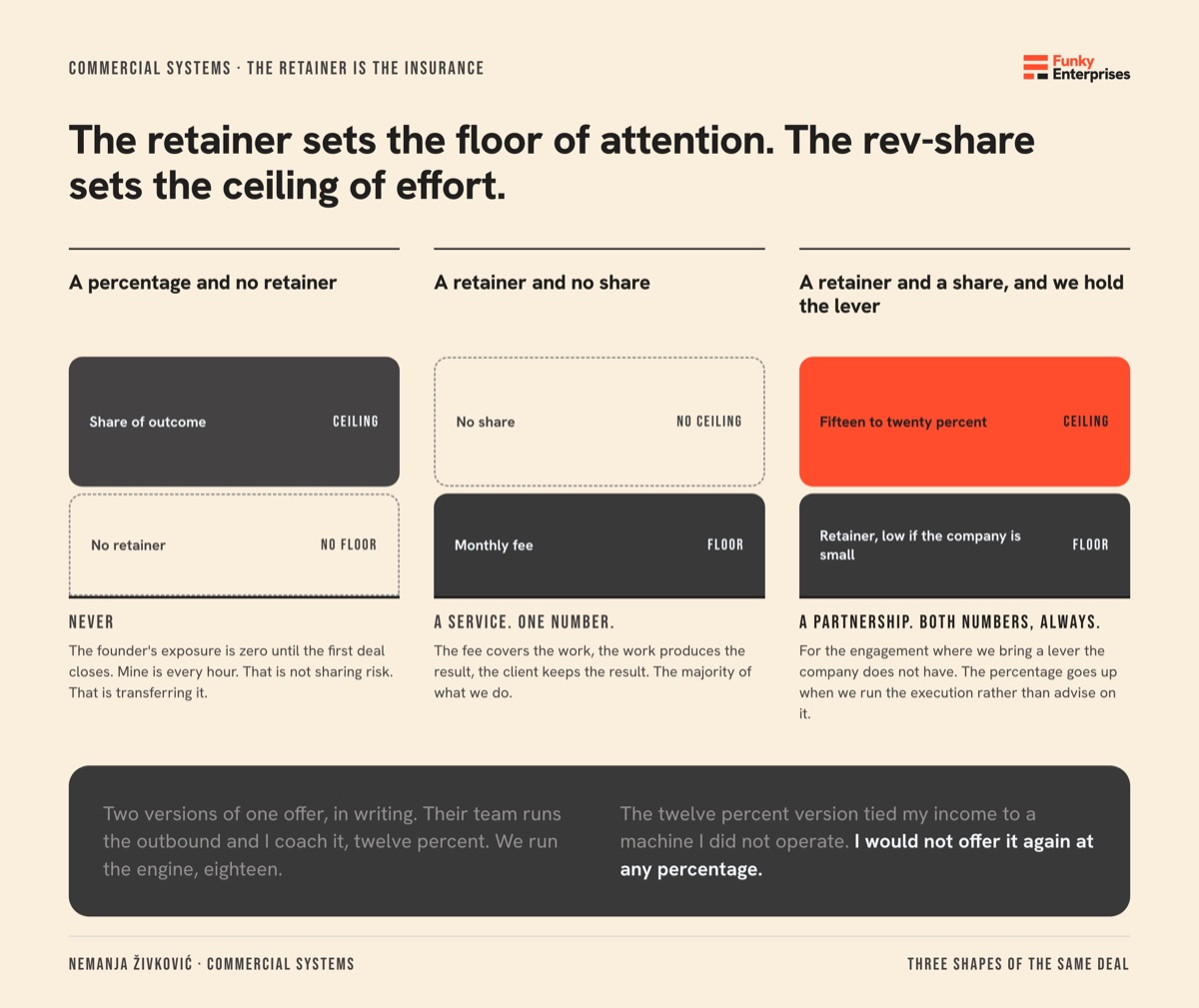
When a founder offers no retainer, what they are actually saying is: you carry the cost of all the work that has to happen before we know if this works, and we carry none of it. That is not sharing risk. That is transferring it. The founder’s exposure is zero until the first deal closes, at which point they pay a percentage of money they would not otherwise have had. My exposure is every hour from day one.
I wrote about the same shape in September in the piece on free door math, which was about how much unpaid pre-sale work a company does before the first invoice. The pure rev-share offer is the free door with a longer hallway. The door is open, the work starts, and the first invoice is somewhere in the future, conditional on things that may or may not be in your hands.
What a rev-share is actually for
If the retainer is insurance, the rev-share is a bet. And a bet is only a bet if you hold the thing you are betting on.
This is the part that took me the longest to understand, and it is the part most people miss. A percentage of revenue is worth exactly as much as your control over the thing that produces the revenue. If I take eighteen percent of deals that close through an outbound engine, that eighteen percent is a bet on my ability to build and run that engine. I hold the list, the message, the cadence, the follow-up discipline, the measurement. If it does not work, that is on me, and I can look at every part of it and change it.
Now take the same eighteen percent, but the engine sits with the client’s team. I coach, I advise, I review. They send the messages. They do the follow-ups, or do not. They decide, on a Thursday when three other things are on fire, whether the sequence gets its second touch. My eighteen percent is now a bet on their discipline. I do not hold the lever. I am scratching somebody else’s lottery ticket.
Earlier this year I put this exact choice in writing to a software company. Two versions of the same offer. In the first, their team ran the outbound and I coached it, at twelve percent. In the second, we ran the engine ourselves, their people supported it under our lead, at eighteen percent. The founder chose neither. The stated reason was price, and I think the honest reason was that we were not the right fit for each other, which is fine, and which I would rather have found out then than six months in.
But writing those two versions side by side did something for me. It made the difference visible. The twelve percent version was structurally wrong, not because twelve is a bad number, but because it tied my income to a machine I did not operate. I would not offer it again at any percentage.
The rule we run now at Funky Enterprises is simple to say. If our compensation is tied to an outcome, we control the execution that produces the outcome. The client’s team is support, under our lead, never an autonomous unit we depend on for our own payout. It means more work for us. It also means that if the number is bad, I know exactly whose fault it is.
The sentence I got wrong
In August I wrote a LinkedIn post about getting paid, and somewhere in the middle of it I wrote that every Funky contract has two numbers, a retainer and a share of the outcome. It read well. It was also wrong, and a partner of mine pointed it out within the hour.
Most of our engagements have one number. A company hires us to build or run a piece of their commercial system, we agree a monthly fee, and that is the whole structure. There is no rev-share because there is no separate upside to capture. The fee covers the work, the work produces the result, the client keeps the result. That is a normal service engagement and it is the majority of what we do. I fixed the post the same day.
The two-number structure is for a specific kind of engagement: the one where we bring a commercial lever that the company does not have. Placement, positioning, distribution, a market we can open that they cannot. In those, the retainer still covers the work, because the work still happens. But the lever produces an upside beyond the work, and the rev-share captures our share of that upside. Both numbers, always. The retainer can be low if the company is small. The percentage goes up when we run the execution rather than advise on it, fifteen to twenty, because we are doing the job, not commenting on it.
What is never on the table is one number without the other in a partnership deal. A pure rev-share, or equity without a retainer, means we risk our own work on somebody else’s outcome, and I have already explained why that is not a bet. The reason I am spending a whole section on my own mistake is that the wrong sentence is the one people repeat. “Everything is retainer plus rev-share” sounds like a philosophy. It is not. It is a category error that makes the standard engagement look like it is missing something.
What the structure does for the other side
I want to be careful here, because this can read like a consultant defending his fee. So let me argue the client’s side, because the structure is better for them too, and not out of charity.
The retainer sets the floor of attention. A partner with no fixed income from you will be on your account exactly as long as nothing else pays better. That is not a character flaw, it is arithmetic. The week a paying client calls, the free one waits. If you have ever wondered why the “we only earn when you earn” partner went quiet in month three, this is why. You bought the cheapest version of their attention and you got it.
The rev-share sets the ceiling of effort. A partner on a flat fee has no reason to push past the scope. They do the work, they invoice, the result is yours. That is fine for a service. It is the wrong shape for a partnership where the whole point is to open something you could not open alone. The percentage is what makes the partner come back on a Friday evening to fix the sequence that is underperforming, because their income depends on it. You are not paying for hours at that point. You are paying for the fact that they cannot walk away from a bad number.
And control over execution protects the client as much as the partner. If the partner holds the lever, the client can hold the partner accountable for the outcome. If the client’s own team holds the lever and the partner “advises”, nobody is accountable. The client blames the advice, the partner blames the execution, and the number sits there unowned. I wrote in September about the seam between marketing and sales, and how in most companies it is nobody’s job to look at the number that sits there. A badly structured partnership creates a new seam, between the company and the partner, with the same empty chair in front of it.
Where this sits in the commercial system
I keep coming back to the phrase commercial system because it is what this newsletter is about and because the deal structure is not a side topic to it. It is the pricing decision of the system, applied to partners instead of customers.
When we take a company through its own pricing, the question is always the same: which of your work is conditional on outcome and which is not, and are you charging for both? The company that quotes a fixed project price for work that includes three months of unpaid discovery has answered that question wrong. The company that quotes only a success fee for a project whose success depends on the client’s own team has answered it wrong in the other direction.
The same two questions apply to every partnership you enter, from either side. What work happens regardless of outcome, and who pays for it? What lever produces the outcome, and who holds it? Retainer answers the first. Rev-share, with control over execution, answers the second. A deal that only answers one of them is not a partnership. It is a hope with a signature on it.
There is a third thing we added as Funky Enterprises grew from one person into a group of partners with their own businesses. Whoever brings the deal bills their share. It sounds obvious and it prevents the most common argument inside a partnership, which is not about the work but about who gets credit for the door opening. Write it down before the first deal, not after.
What I propose instead
When the offer comes now, I do not say no. I say this.
A retainer, small, sized to what a company at that stage can carry without it hurting. Enough to cover the work that happens before the first deal, listed line by line with hours against it so it does not look like a number pulled from the air. And a share of what closes, which I am happy to make higher than whatever they first offered, because with the retainer in place I can actually commit the time to make the engine work. One condition: we run it. Their sales lead joins the calls, their product person answers the technical questions, but the list, the message, the cadence and the measurement sit with us.
Some founders take it. Some say the retainer is the problem, cash is tight, and the whole appeal of the original offer was that it cost nothing until it worked. I understand that. I also know what the original offer would have cost me, and that in month three, when a paying client calls, they would have found out too.
The ones that say no, I do not regret. What I regret is the years before I could explain this clearly, when I took two or three of those deals because the upside looked good and the founder seemed serious, and then watched them go exactly the way the arithmetic said they would.
One question, and I would like the honest version. Look at the last partnership you offered, or were offered. Which of the two questions did it answer, and which one did everybody at the table quietly agree not to ask?
Written by
Nemanja Živković, Strategy Director and Founding Partner at Funky Enterprises. He builds commercial systems for B2B companies: positioning, marketing, sales and customer success working as one. More about Nemanja · nemanjazivkovic.co
Also published in the Commercial Systems newsletter. Read it on Substack