Nemanja Živković, Strategy Director, Founding Partner · 6 October 2026
The Pricing Leak: I Charged Three Thousand Because Serbia Was Watching
In 2020 I put my prices on the website, three to ten thousand euros, while the people I was actually competing with started at fifteen. Here is who set that number, and what it cost.
A pair of Jordan 1s costs the same in Novi Sad as it does in Chicago. Nobody at the register asks where you grew up before they scan the box. I have thought about that more than a grown man should, because for the first two years of my company I priced my work as if the register did ask, and the answer was always the same. Serbia. Charge less.
This is the most personal piece I will write on this newsletter, and it is here because every founder I audit has a version of it. The number on your price list was not set by your costs, or your market, or your competitors. It was set by whoever you imagined reading it. I want to walk through mine, with the actual figures, because the arithmetic of a badly placed anchor is more brutal than the story sounds.
The number, and where it came from
I started Funky Marketing in January 2020. Before that I had spent a few years as a remote general manager for an agency in Toronto, and the people I learned from there, Americans and Canadians, taught me one thing about pricing that I still believe. Put the price on the website. Do not hide behind “contact us for a quote”. A buyer who cannot see your price assumes it is either too high for them or too low to be serious, and either way they do not write.
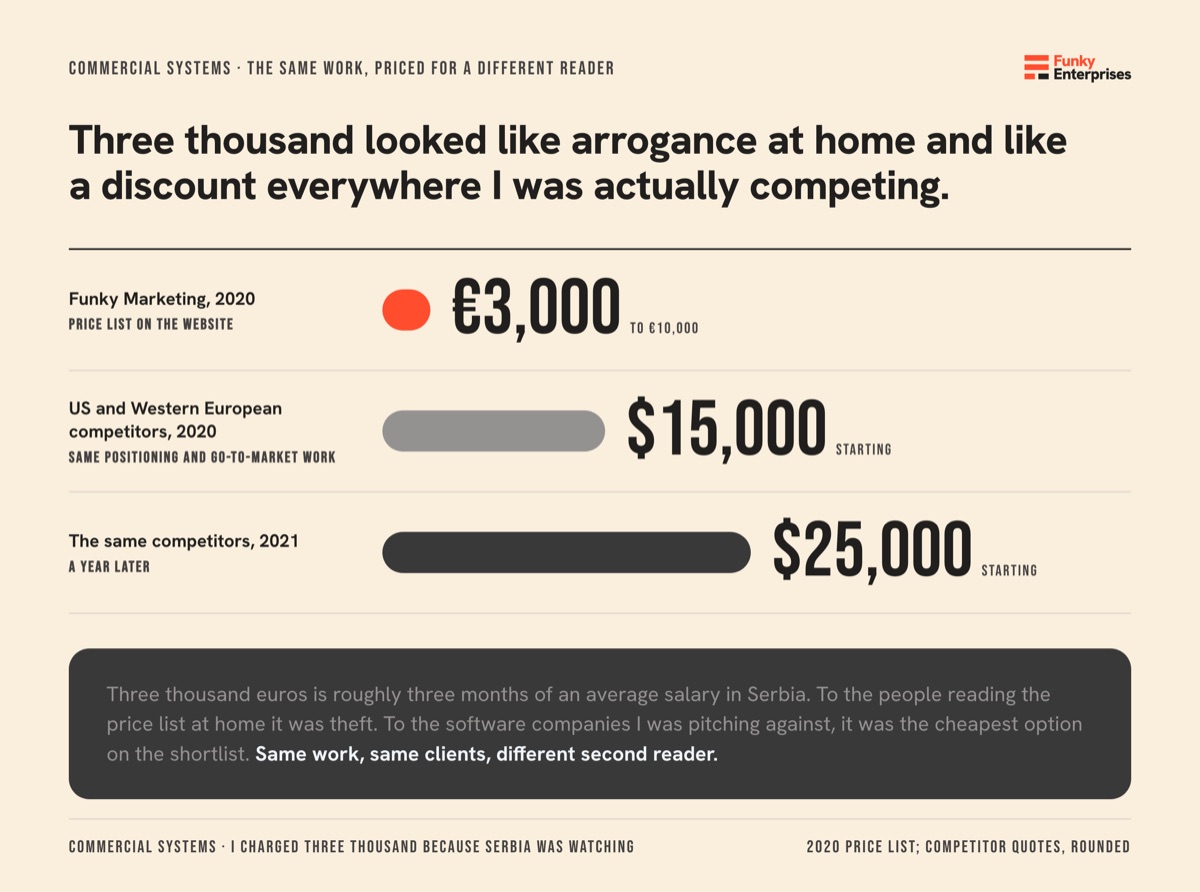
So the prices went on the site. Three thousand euros for the smallest engagement, up to ten for the biggest. For a while the real range was three to five, and it took months before anyone paid ten.
Here is the context that matters for the story. The people I was actually competing with, the B2B agencies and consultants in the US and Western Europe doing the same kind of positioning and go-to-market work for the same kind of software companies, were starting at fifteen thousand dollars at the time. A year later most of them had moved to twenty-five. My clients were in the same countries as theirs. My clients were, in a few cases, talking to them and to me in the same week.
If I had priced against them, I would have started at twenty. I know that because I did the math at the time and then did not act on it.
I priced at three because of who I thought was watching.
Who was watching
The first year, something happened that I did not expect. The attacks did not come from clients. Clients paid the three, the five, eventually the ten, and stayed. The attacks came from the ecosystem at home.
People from the Serbian marketing scene, some of whom I had considered friends, started asking publicly who I was to charge that much. What experience I had. What gave me the right. Not in private messages, in comment sections, where other people could read it. Three thousand euros is roughly half a year of an average salary in Serbia at the time, and to someone in that ecosystem it looked like arrogance, or theft, or both.
And I cared. That is the part I am least proud of. I read every comment. I explained myself in replies. I thought about it when I was writing proposals, and I can tell you exactly how it showed up in the proposals: every time I sat down to write a number, there was a second reader in the room who was not the client. The client was a software company in Berlin or Boston with a marketing budget bigger than my annual revenue. The second reader was a guy in Belgrade with opinions. I wrote the number for the guy in Belgrade.
I want to be precise about this, because it is easy to turn it into a story about haters. The people commenting were not stupid and most of them were not malicious. They were pricing against their own market, which is a real market, where three thousand euros for a strategy engagement is genuinely a lot. Their mistake was assuming my market was theirs. My mistake was letting them.
The arithmetic of the wrong anchor
Let me put numbers on it, because the story sounds like a feelings problem and it was a balance sheet problem.
Say the first two years produced somewhere around twenty engagements in the three to ten range. Take an average of five. That is about a hundred thousand euros of revenue from work that, priced against the people I was actually competing with, would have started at fifteen or twenty per engagement. Same work. Same clients. Same deliverables, in some cases literally the same document structure that the fifteen-thousand-dollar agencies were selling.
At fifteen, those twenty engagements are three hundred thousand. The difference, two hundred thousand euros over two years, is not a rounding error for a company of my size at the time. It was the difference between hiring the second senior person in year one and hiring them in year three. It was every tool I paid for out of my own pocket instead of the client’s budget. It was two years of working at a pace I would not recommend to anyone.
And here is the part that took me longest to understand. The clients who paid three did not value the work at three. Several of them told me later, once we knew each other well, that they had been surprised by the price and had assumed there was a catch. One said they had budgeted for four times the number. The low anchor did not win me the deals. It made the deals I won smaller, and it made a few good prospects suspicious enough to go elsewhere.
That is the mechanism I want you to take from this. A price set by the wrong audience does not just cost you margin on the deals you close. It costs you deals, because the right audience reads a low number as a signal about quality, and they are not wrong to.
What changed, and when
Two things changed it, and neither of them was a pricing course.
The first was volume. That first year produced forty-seven inbound B2B engagements, almost all of them from LinkedIn, and when you have forty-seven conversations with buyers in a year you start to hear the same thing over and over. Nobody outside Serbia asked why the price was so high. Several asked why it was so low. After enough of those, the guy in Belgrade gets quieter in your head, because the evidence is stacking up against him.
The second was a specific moment I will not dress up. A prospect, a company I would have loved to work with, went with a competitor who charged four times what I had quoted, and when I asked why, the answer was that the competitor’s number felt like the number for a serious project. That was the day the anchor moved. I did not become better at the work between the quote and that call. I became more expensive.
Today we are expensive. I say it plainly in the first conversation. Our audit has a price, and it is credited against the first invoice if the engagement goes ahead, which I wrote about a few weeks ago in the piece about the free door. The retainers are priced against the US market, because the clients are in the US market. And I can tell you what happened to the ecosystem comments: they stopped. Not because people agreed. Because a number that has been on the site for years, and has clients attached to it, stops being a provocation and becomes a fact.
The anchor does not drop before an answer
I would like to tell you that once I learned this I never did it again. That would be a lie, and I keep this newsletter honest, so here is what it looks like six years later.
Earlier this year we sent a personal branding proposal to a well-known public figure at home. Twelve months, a phased ladder, starting at three thousand. Our own internal floor for that kind of work was five. I started at three because of who the person was, and because of the same old reflex: a Serbian buyer, a Serbian number. There was no answer. Not a no, just silence. And the reflex, the same one from 2020, was to write back with a smaller number.
We did not, because by then I had a rule that I will give you as the single most useful sentence in this piece. Silence is not a price objection. A prospect who does not reply has not told you the price is wrong. They have told you nothing. Dropping the anchor into silence does not answer an objection that was never made; it just hands over margin to someone who had not even asked for it. If they come back, they come back to the same number. If they do not, the number was never the reason.
Around the same time, a different prospect in a different sector had gone through a similar shape. Early conversations at one price, then a smaller scope at less than half, offered before they had said a word about budget. I offered the discount to myself. Nobody negotiated me down. I did it pre-emptively, because a second reader was in the room again.
And then in August one more, which I include because it is the cleanest version of the lesson. A small AI advisory firm in my city, whose founder asked whether we work with companies their size. We sent a modest starting package. The reply was that it was too expensive, and that a single LinkedIn post, by their calculation, came out to around ten thousand dinars, which is about eighty-five euros. This from a firm whose own advisory engagements, according to their own materials, run between twenty-five and fifty thousand euros.
The 2020 version of me would have taken that comment personally and gone home to rewrite the offer. The 2026 version looked at the gap between what they charge and what they were willing to pay, and concluded that the problem was fit, not price. We closed the conversation politely. No smaller package, no follow-up, no wounded reply. A buyer who prices your work at eighty-five euros a post has told you who they are, and you are allowed to believe them.
The version of this in your company
You are probably not in Serbia. That does not mean you do not have a Serbia.
Every founder I have audited had a second reader in the room when they set their price. For a lot of American founders it is the Slack community they came up in, where everyone knows what everyone charges and the fastest way to get side-eye is to charge more. For agency owners it is the former boss whose rates they still measure against. For technical founders it is the engineering peers who think anything above a developer’s hourly rate is grift. For a lot of people it is a parent who never earned that much in a month.
Here is how to find yours. Take your current price list, or the last three proposals you sent. For each number, ask one question: who would be embarrassed if this number were higher? If the honest answer is “the client”, fine, that is a real constraint and you can work with it. If the honest answer is anyone else, you have found your Serbia, and that person has been setting your prices without carrying any of your risk.
Then run the arithmetic I ran above. Take last year’s engagements, reprice them at what your actual competitors charge for the same scope, and look at the difference. That number is what the second reader cost you. I have done this with founders and watched the room go quiet. The engineering firm from the margin piece, the one quoting four hundred and seventy a day and delivering at two hundred and fifty, had a version of it too. The quoted rate was fine. The delivered rate was set by the fear of what the client would say if the extra days were on the invoice. Different second reader, same mechanism.
What I actually do now
I will keep this short, because the point of the piece is the story, and the practice is simple.
Prices live on the site. That has not changed since 2020 and I would not run a services business any other way. A buyer who sees the number and writes anyway has qualified themselves.
Every price is set against the market the client is in, never the market I am in. If the client is in the US, the price is a US price, and the fact that my rent is in dinars is my competitive advantage, not the client’s discount.
The anchor never moves before an objection is made in words. Silence gets a follow-up, not a discount. “Too expensive” gets a conversation about scope, and if the gap is the kind of gap the AI firm showed me, it gets a polite close.
And I stopped reading the comments. Actually, that is not true. I read them. I just stopped writing proposals for the people who leave them.
A loud comment section is a crowd, and the crowd does not get a vote. The scoreboard does. Six years in, I finally price like that.
One question, and I would genuinely like the answer, in a reply or just for yourself. Who is the second reader on your price list? Name them. If you can, you are already halfway to the number you should be charging.
Written by
Nemanja Živković, Strategy Director and Founding Partner at Funky Enterprises. He builds commercial systems for B2B companies: positioning, marketing, sales and customer success working as one. More about Nemanja · nemanjazivkovic.co
Also published in the Commercial Systems newsletter. Read it on Substack